
Reviewed · GOLF CART TOURS
Krakow: City Sightseeing Tour Eco Electric Buggy Golf Cart
Krakow’s electric buggy tour is really two city stories in one: the old Jewish quarter of Kazimierz, followed by the former Jewish ghetto in Podgórze. In about 90 minutes, you cover ground that would take much longer on foot, passing synagogues, churches, squares, the old ghetto wall, and Oskar Schindler’s former factory.
I like the easy central meeting point and the warm, covered buggy, especially in Krakow’s cold or wet weather. I also like the mix of live guiding and recorded narration, with guides such as Olivia, Natalie, Philip, Jacob, and Oskar praised for clear English and useful local detail. The main drawback is that this is primarily a sightseeing ride, not a museum tour, and a full buggy can feel cramped.
In This Review
- Key points before you book
- What this Krakow buggy tour really offers
- Starting near Krakow’s old town
- Skałka, the church on the Rock
- Plac Wolnica and the old Kazimierz marketplace
- Churches, courtyards, and the Jewish quarter
- The synagogues of Kazimierz
- Tempel Synagogue
- Kupa Synagogue
- Izaak Synagogue
- High Synagogue
- Old Synagogue
- Wolf Popper Synagogue
- Rubinstein’s Krakow connection
- Remah Synagogue
- Crossing to Podgórze and the former ghetto
- Ghetto Heroes Square and Eagle Pharmacy
- Schindler’s Factory and the old ghetto wall
- St. Joseph’s Church in Podgórze
- Guides, narration, and the group atmosphere
- Daylight, weather, and the best time to ride
- Who will get the most from this tour
- Should you book the Krakow electric buggy tour?
- FAQ
- How long does the Krakow electric buggy tour last?
- Where does the tour start?
- Is the tour offered in English?
- Does the tour enter Schindler’s Factory?
- Which Krakow districts does the tour visit?
- Is the buggy warm in winter?
- Can I cancel for a full refund?
Key points before you book
- About 24 sights in 90 minutes: This is a quick city orientation, not a slow walking tour.
- Kazimierz is the main focus: Expect many synagogues, Jewish quarter landmarks, and historic squares.
- Podgórze adds wartime context: The route includes Ghetto Heroes Square, Eagle Pharmacy, Schindler’s Factory, and part of the old ghetto wall.
- Warm in poor weather: Blankets and heating have made the ride comfortable on cold and rainy days.
- Mostly exterior viewing: You may enter a church, but the route does not include a full visit inside Schindler’s Factory.
- Group size can affect comfort: The stated maximum is 50, and some departures may place a dozen people in one buggy.
What this Krakow buggy tour really offers
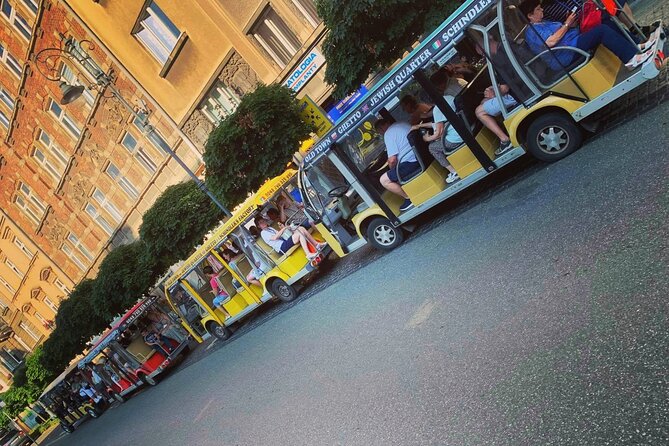
Think of this as a moving introduction to Krakow. You sit back while the driver handles the streets and points out places that are spread across Kazimierz and Podgórze.
The route is useful because these districts are close enough to connect in one outing, yet far enough apart to make a long walk tiring. You get a quick sense of how Krakow’s religious, royal, commercial, and wartime stories overlap.
The tour costs $28.88 per person. That is fair if you value saved walking time and a guide who can give you the broad picture. It is less of a bargain if you expect long stops, museum admissions, or detailed exploration of every site.
I would book it early in your stay. The ride helps you get your bearings, and you can return later to the places that deserve more time. Some people use it near the end of a trip to fill an empty hour, but the information is more useful before you begin exploring on your own.
More golf cart tours of Krakow:
- Krakow: City Sightseeing Tour by Electric Golf Cart
★ 4.5 · 3,264 reviews - Krakow: City Sightseeing Tour Eco Electric Buggy Golf Cart
★ 4.7 · 3,143 reviews - Krakow: Extended City Sightseeing Tour – Eco Buggy Golf Cart
★ 4.7 · 794 reviews
Starting near Krakow’s old town
The meeting point is at the 24H Krakow old town car park on Mikołaja Zyblikiewicza 2. It is an easy location once you are on the main Westerplatte street. The pickup point is across from a Żabka shop, which is a useful landmark if you are unsure where to go.
Pickup may be offered, but the listed start point remains important. Give yourself enough time to find the buggy, especially if you are arriving from another part of the old town.
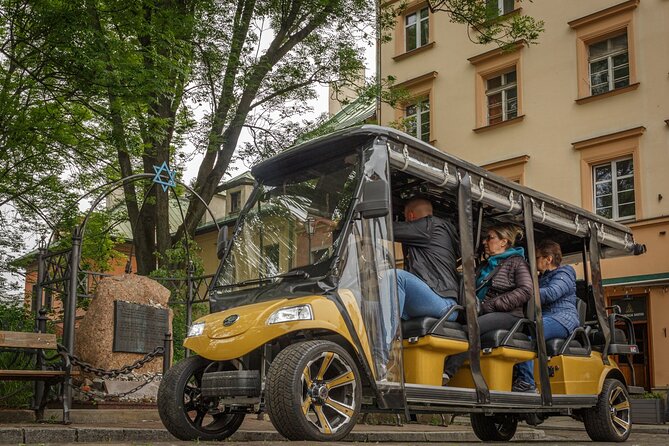
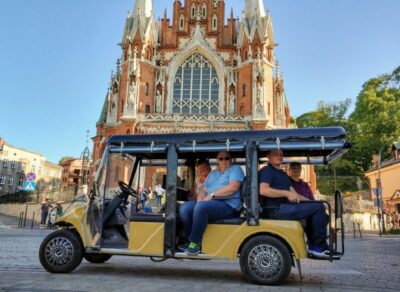
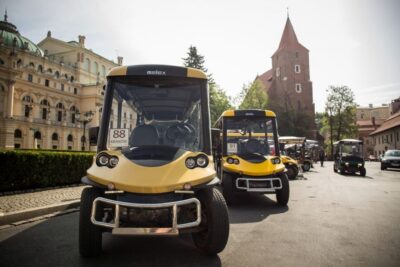
The vehicles are electric golf-cart style buggies. They are open enough for good views but covered and fitted with heating. Blankets are also available, which makes a real difference in winter. One ride took place in very wet weather and was still described as comfortable, thanks to the warm vehicle and careful driving.
The road can be a little bumpy. That is part of the trade-off for using a small vehicle on Krakow’s streets. If you have a sensitive back, sit where you can brace yourself comfortably and expect a city ride rather than a smooth coach journey.
Skałka, the church on the Rock
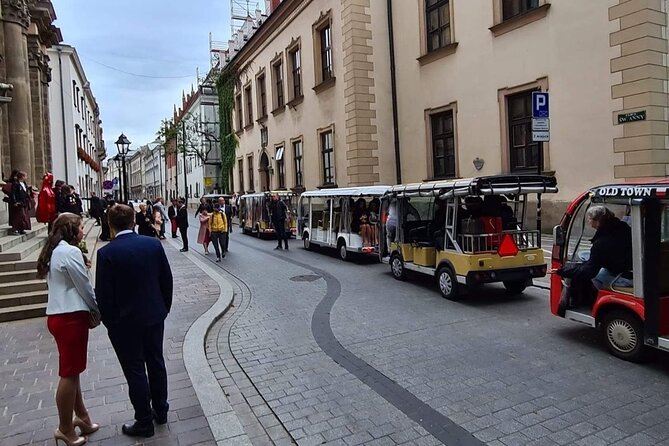
The first major stop is Skałka, formally the Basilica of Saint Michael the Archangel and Saint Stanislaus the Bishop and Martyr. The name means a small rock, and the church sits above the spot where Stanislaus, Bishop of Krakow, was killed on the order of King Bolesław II in 1079.
That murder led to the king’s exile and, later, the bishop’s canonization. The site is tied to one of Poland’s most important medieval religious and political conflicts.
You get about 10 minutes here, with free admission listed for the stop. That is enough to see the church and take photos, though not enough for a close study of every detail. The church is one of the more rewarding early stops because it gives the tour a clear historical anchor before the route moves into Kazimierz.
Plac Wolnica and the old Kazimierz marketplace
Plac Wolnica was once the market square of Kazimierz, a separate city founded in 1335. In its early days, it was comparable in size and function to Krakow’s Main Market Square.
Trade took place here, and the square once held a town hall, stalls, scales, and a shearing room. Its name comes from the Latin Forum liberum, linked to the right to sell meat outside the regular stalls.
You will not get a full medieval market experience today, but the square helps explain that Kazimierz was once its own urban center. The tour passes through a number of places where the district’s Christian and Jewish communities lived close together, and Plac Wolnica is a good point for understanding that wider layout.
A few more Krakow trips worth comparing
- Creepy Krakow: 2-Hour City Walking Tour
★ 4.7 · 1,131 reviews - Krakow: City Pass With Transport
★ 4.1 · 575 reviews - Krakow: Guided City Tour by Golf Buggy (with hotel pickup)
★ 5.0 · 426 reviews - Private Departure Transfer: Krakow City To Krakow Airport Balice
★ 4.5 · 367 reviews
Churches, courtyards, and the Jewish quarter
The route includes a basilica built in stages from about 1340 through the mid-15th century. It was designed as a monastery church, which explains its large plot and the former monastic cemetery beside it. In 1404, King Władysław II Jagiełło gave the church to the Canons Regular of the Lateran.
Another stop recalls the old Libuszhof area, a group of streets and buildings whose present shape developed through city planning projects in 1808 and 1844. Along the northern side, houses once connected with the Jewish hospital near Kupa Synagogue remain part of the story.
These details can pass quickly from a moving buggy, so pay close attention to the guide’s explanation. The value here is not a long look at one building. It is seeing how Kazimierz developed as a layered district, with religious institutions, homes, hospitals, trade, and public spaces packed into a small area.
The synagogues of Kazimierz
The synagogue section is the heart of the tour. You pass several important buildings, but you should be clear about the format: the buggy gives you an outside view and historical explanation, while a separate museum visit is needed for a full interior experience.
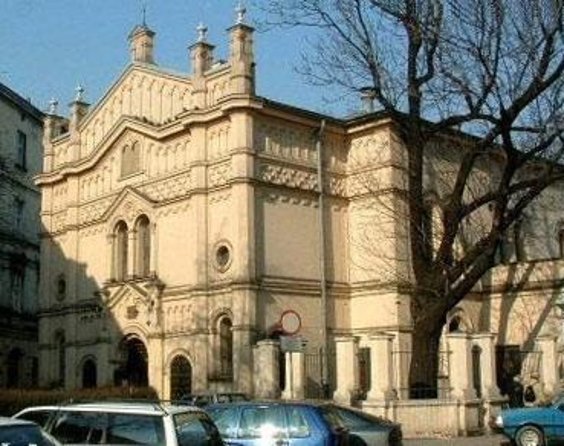
Tempel Synagogue
Tempel Synagogue is both a place of worship and a center for Jewish cultural events. It hosts concerts and meetings, including events connected with Krakow’s Jewish Culture Festival.
It is a useful stop for showing that Jewish life in Kazimierz is not only a matter of the past. The building remains connected to religious and cultural activity today.
Kupa Synagogue
Kupa Synagogue dates from the 17th century and sits in the former Jewish quarter. The district was formally set aside for Krakow’s Jewish community in 1495, after Jews were moved from the developing old town.
Kupa continues to serve as a setting for religious ceremonies and cultural events. The guide’s explanation helps connect the synagogue to the wider history of the neighborhood rather than treating it as an isolated monument.
Izaak Synagogue
The Izaak Synagogue was built in 1644 and named after Izaak Jakubowicz, also called Isaac the Rich. He was a banker to King Władysław IV of Poland.
The synagogue was designed by Francesco Olivieri, an architect born in Italy. That detail hints at the wider links between Krakow and the artistic world beyond Poland.
High Synagogue
The High Synagogue is also called the Tall Synagogue. Its name refers either to its height or to the fact that the prayer room was upstairs.
It is the tallest synagogue in Krakow and an example of late Renaissance architecture. Today it is inactive, so the buggy tour is a useful way to see the building as part of the street scene without expecting a regular service or museum visit.
Old Synagogue
The Old Synagogue is the oldest synagogue building still standing in Poland. Before the Second World War, it served as a major religious, social, and organizational center for Krakow’s Jewish community.
This is one place I would return to on foot if you have time. The buggy gives you the essential context, but the building deserves a slower look and a dedicated museum visit.
Wolf Popper Synagogue
Wolf Popper Synagogue was founded in the early 17th century by Wolf Popper, known as The Stork. It was once a highly decorated house of prayer, with porches, side buildings, furnishings, and an ornate Torah ark.
Its former grandeur faded after the founder died. Today, the building is used as a bookshop and art gallery, with the women’s section upstairs. That later use adds another layer to the route: Krakow’s historic buildings have not all remained frozen in one period.
Rubinstein’s Krakow connection
The tour also points out the Krakow connection of pianist and musician Anton Rubinstein. He was born to Polish Jewish parents, and his father ran a shop in Krakow when the city was under Austro-Hungarian rule after the partitions of Poland.
This is a brief biographical detail rather than a major stop, but it adds a personal face to the district’s past. Kazimierz was home to working families, business owners, religious leaders, artists, and scholars, not just famous buildings.
Remah Synagogue
The Remah Synagogue is the smallest of Kazimierz’s historic synagogues. It dates from the 16th century and is named after Rabbi Moses Isserles, known by the Hebrew acronym ReMA.
It is one of only two active synagogues in Krakow. The stop is especially worthwhile for showing that Jewish worship remains part of the city today, even as the district also serves as a major cultural and dining area.
Crossing to Podgórze and the former ghetto
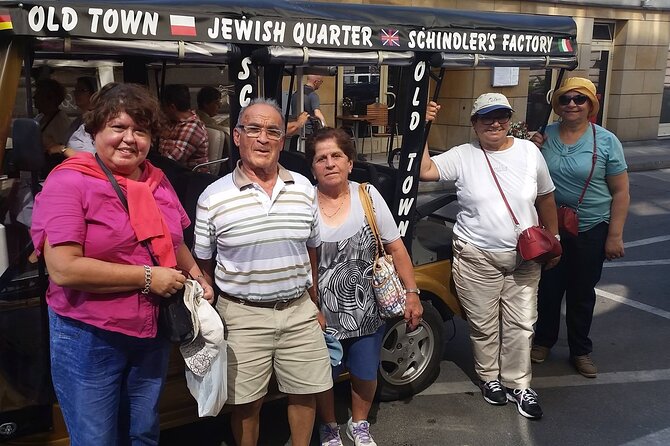
The route then moves across the river toward Podgórze. This shift matters. Kazimierz tells you about Jewish life and community before the war, while Podgórze shows what happened after the German occupation forced Krakow’s Jews into a sealed ghetto.
The route includes Ghetto Heroes Square, formerly known as Plac Zgody. From 1941 to 1943, it was a place where Jewish residents were concentrated before deportation to concentration camps.
This is a serious part of the tour. The ride is convenient, but the subject calls for quiet attention. You may find the guide’s explanation more affecting than the quick views of the buildings themselves.
Ghetto Heroes Square and Eagle Pharmacy
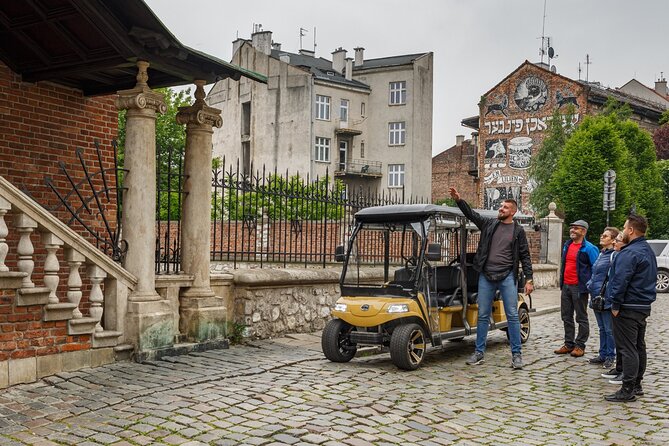
Ghetto Heroes Square is one of the key wartime sites on the route. At number 18, the Eagle Pharmacy operated under Tadeusz Pankiewicz, the only non-Jewish resident of the ghetto with permission to remain there.
Pankiewicz’s pharmacy had served both Polish and Jewish customers before the war. During the ghetto years, it became a place connected with aid, information, and the daily struggle of people trapped inside.
The Eagle Pharmacy is now a museum. The buggy passes the site, but the tour does not replace a museum visit. If the wartime story is a main reason you are in Krakow, set aside separate time to go inside and read the exhibits at your own pace.
Schindler’s Factory and the old ghetto wall
The route passes Oskar Schindler’s former enamel factory at Lipowa 4. The complex now contains the Museum of Contemporary Art in the former workshops and a branch of the Historical Museum of Krakow in the former administrative building.
The factory is linked with Oskar Schindler’s Deutsche Emailwarenfabrik and with the story shown in the film Schindler’s List. The original factory began as a metal and enamelware business in the 1930s, before Schindler’s operation took over during the war.
Here is the important practical point: you pass Schindler’s Factory, but you do not tour its museum during this buggy experience. If you want to see the exhibitions, buy or arrange a separate visit.
The buggy also passes a surviving section of the old ghetto wall. This is a short visual stop, but it makes the boundaries of the former ghetto easier to understand. A wall fragment can communicate the physical confinement more clearly than a general lecture.
St. Joseph’s Church in Podgórze
The final major landmark is St. Joseph’s Church on Podgórski Square. This historic Catholic church sits on the northern slopes of the Krzemionki foothills.
Its location helps you see how Podgórze differs from Kazimierz. The district has its own square, church, streets, and hill setting. The tour does not spend long at each place, but the changing scenery gives you a useful sense of Krakow beyond the old town center.
Guides, narration, and the group atmosphere
The driver-guide is a major part of the experience. Olivia has been especially effective at combining clear English, humor, timing, and sensitivity when discussing the ghetto. Natalie has been praised for careful driving and for using photos on her phone to make certain sites easier to understand.
Philip, Jacob, and Oskar have also led informative rides. The exact guide depends on the departure, so do not book expecting a particular person. Still, the tour clearly depends on having a good guide, since the buggy itself only gets you from place to place.
Recorded narration adds another layer. When the audio works, it helps fill in details while the driver concentrates on the road. Bring your patience for the equipment, though. A few passengers have found that some earphones did not work properly.
The group can be social, and you may make new friends during the ride. But space is limited. One departure placed nine large adults and a family of three in a single buggy, with winter clothing making the seating very tight. The stated maximum of 50 applies to the overall activity, not necessarily to one vehicle, so ask the driver for help if the seating feels unsafe or uncomfortably cramped.
Daylight, weather, and the best time to ride
Book in daylight if possible. Night rides can be enjoyable, and Krakow has a different mood after dark, but it is harder to see building details and take good photos.
Winter is not a reason to avoid the tour. Heating and blankets make the buggy a welcome break from cold streets, and the covered vehicle has been comfortable even in rain. You should still dress for outdoor conditions because you may pause outside the buggy.
The 90-minute duration is long enough for a useful introduction but short enough to fit before dinner, a museum visit, or a flight. The ride returns to the starting point, which makes planning easier.
Who will get the most from this tour
I would recommend this ride if you want:
- A quick overview before exploring Krakow on foot
- A way to cover Kazimierz and Podgórze without a long walk
- A warm option for cold or rainy weather
- Clear English explanations from a local driver-guide
- An introduction to Krakow’s Jewish quarter and wartime sites
- A comfortable first look at places you may revisit later
It is less suitable if you want long interior visits, a castle and old town tour, or a detailed museum experience. Some people expect the route to include Wawel Castle and more of the old town, but the listed route focuses heavily on Kazimierz and the former ghetto.
Should you book the Krakow electric buggy tour?
Book it if you want to get your bearings fast, rest your legs, and understand the relationship between Kazimierz and Podgórze. At $28.88, the price works well for a 90-minute ride with a guide, heating, blankets, and a route covering about two dozen sights.
Do not book it as a substitute for Schindler’s Factory, the Eagle Pharmacy Museum, or the synagogues themselves. You will mainly see exteriors, and a crowded buggy can reduce comfort.
My best advice is to schedule it near the start of your Krakow stay, in daylight, and then return on foot to the places that catch your interest. You get the broad map first, then choose where to spend your real time.
FAQ
How long does the Krakow electric buggy tour last?
The tour lasts approximately 1 hour and 30 minutes and finishes back at the meeting point.
Where does the tour start?
It starts at the 24H Krakow old town car park at Mikołaja Zyblikiewicza 2, 31-029 Krakow. The pickup point is across from a Żabka shop on the street near Westerplatte.
Is the tour offered in English?
Yes. The experience is offered in English and includes an English-speaking driver-guide. Recorded narration is also used.
Does the tour enter Schindler’s Factory?
No. The route passes Oskar Schindler’s former factory, but it does not include a museum visit inside.
Which Krakow districts does the tour visit?
The route focuses on Kazimierz and Podgórze, including the former Jewish quarter, the former ghetto area, Ghetto Heroes Square, and sites connected with Oskar Schindler.
Is the buggy warm in winter?
Heating and blankets are provided. The buggy has been used comfortably in cold and rainy weather, though you should still dress for outdoor conditions.
Can I cancel for a full refund?
Yes. You can cancel at least 24 hours before the experience start time for a full refund. Cancellations or changes made within 24 hours are not accepted for a refund.
Just added around Krakow
- Private Guided Tour: Oskar Schindler’s Factory★ 5.0 · 3 reviews
- E-Scooter Krakow sightseeing tour★ 5.0 · 3 reviews
- From Krakow: Zakopane and Thermal Pools Guided Trip★ 5.0 · 3 reviews
- Schindler’s Factory, Ghetto and Plaszow Camp Guided Tour★ 4.7 · 3 reviews
- Kraków: Private Hot Air Balloon Flight with Champagne★ 3.7 · 3 reviews
- Krakow: River Cruise & Guided Visit to Former Plaszow Camp★ 3.6 · 3 reviews
- From Krakow: Private Wieliczka Salt Mine Tour★ 4.0 · 3 reviews
- Krakow: Old Town short walk with St. Mary’s Basilica visit★ 5.0 · 3 reviews
Golf Cart Tours, compared.
City Sightseeing Tour Eco Electric Buggy Golf Cart
Read our review →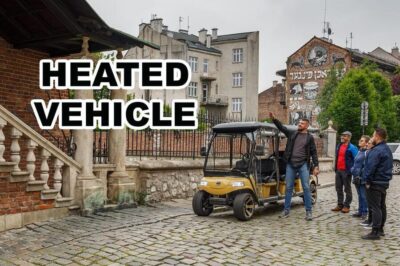
Extended City Sightseeing Tour – Eco Buggy Golf Cart
Read our review →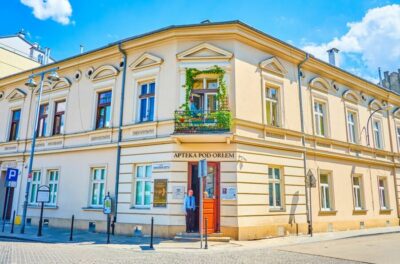
Jewish Quarter and Ghetto Electric Golf Cart Tour
Read our review →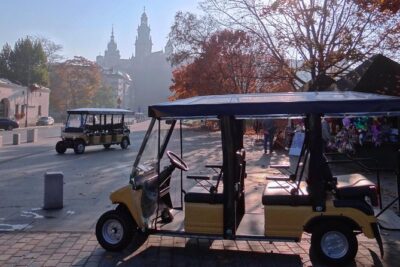
Krakow Grand City Tour by golf cart – All 3 districts
Read our review →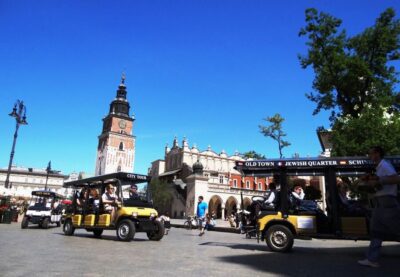
Browse the lists this tour appears in