
Reviewed · WALKING TOURS
Krakow: Highlights of Old & New Town Private Walking Tour
Krakow’s story changes quickly on this private four-hour walk. You move from medieval market stalls and royal tombs to World War II, the Polish People’s Republic, and the modern city of business centers and tourism. That broad time span gives you more than a pretty Old Town stroll.
I like the Royal Route because it links Krakow’s biggest sights in a logical walk, and I like having a guide who can explain both grand monuments and ordinary local life. The chance to ask questions in English, Spanish, French, German, Italian, Polish, or Russian also matters when history gets complicated.
The main drawback is pace. Four hours on foot is a long stretch, especially in rain or snow, and the basic option does not include Kazimierz. Guide quality can also affect the day, so I would treat the private format as a strength, not a guarantee of a perfect performance.
In This Review
- Key points to know before booking
- Starting by the Barbakan and Little Market Square
- Main Market Square and St. Mary’s Basilica
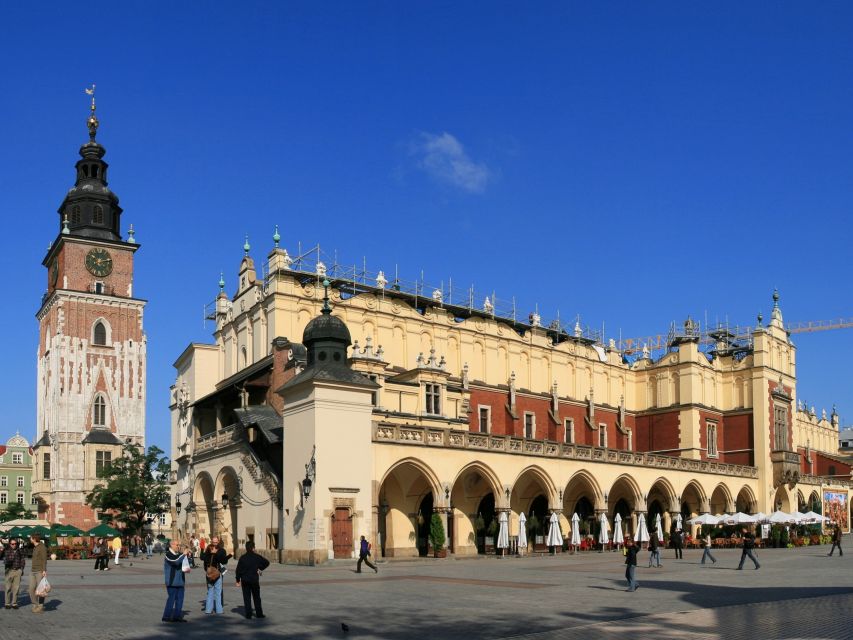
- The Cloth Hall and Krakow’s trading past
- Jagiellonian University and the Royal Route
- Wawel Hill, courtyards, and royal power
- Inside Wawel Cathedral
- The modern story of Krakow
- Choosing the six-hour Kazimierz extension
- Guide quality and the private-tour tradeoff
- Is $137 per person good value?
- Practical details for a smoother walk
- Who should book this Krakow walk?
- Should you book the Highlights of Old and New Town tour?
- FAQ
- How long is the Krakow Old Town and Wawel tour?
- What sights are included in the four-hour tour?
- Is the tour private?
- Which languages are available?
- Does the tour include hotel pickup?
- Does the six-hour tour include Kazimierz and Tempel Synagogue?
- Are museum entrance fees included?
Key points to know before booking
- The Royal Route ties the tour together: Walk from the medieval Old Town to Wawel Hill along the path used by Poland’s kings.
- You get old and modern Krakow: The guide covers medieval power, World War II, the Polish People’s Republic, and life in today’s city.
- The four-hour walk is sight-packed: Expect the Main Market Square, St. Mary’s Basilica, Cloth Hall, Jagiellonian University, Wawel Hill, and Wawel Cathedral.
- A six-hour option adds Kazimierz: The longer version includes the historic Jewish quarter and a ticket to Tempel Synagogue, except when it is closed.
- It is private and language-flexible: You have a licensed guide in your selected language, rather than a large fixed group.
- Pickup has a clear limit: Hotel pickup is available in Krakow’s Old Town, while other participants meet by the Barbakan Krakowski.
Starting by the Barbakan and Little Market Square
The meeting point is in front of the Barbakan Krakowski, on Basztowa, on the Brama Floriańska side of the Old Town. If you are staying within Krakow’s Old Town, pickup from your accommodation may be arranged, but you need to provide the full address when booking.
That detail is worth taking seriously. If your accommodation is more than 1.5 kilometers from the meeting point, or if no address is supplied, you meet at the Barbakan instead. I would check the final email the day before, since pickup details and any itinerary adjustment are confirmed there.
The walk begins at Little Market Square before moving toward Krakow’s main square. This is a sensible opening because you get your bearings before the city’s grandest space appears. The small square also helps set up the contrast between Krakow’s medieval street plan and the larger commercial heart ahead.
Bring shoes with good support. The tour is wheelchair accessible, but it remains a four-hour walking experience, and weather can make the route more demanding than the duration suggests.
More walking tours in Krakow:
- Old Town Krakow & Wawel Castle Walking Tour
★ 5.0 · 1,508 reviews - Creepy Krakow: 2-Hour City Walking Tour
★ 4.7 · 1,131 reviews - Krakow: The Old Town Walking Tour
★ 4.8 · 794 reviews
Main Market Square and St. Mary’s Basilica
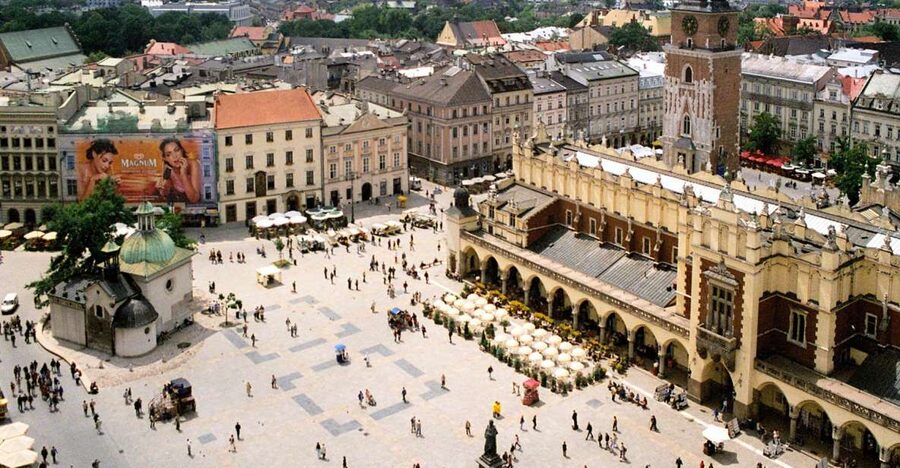
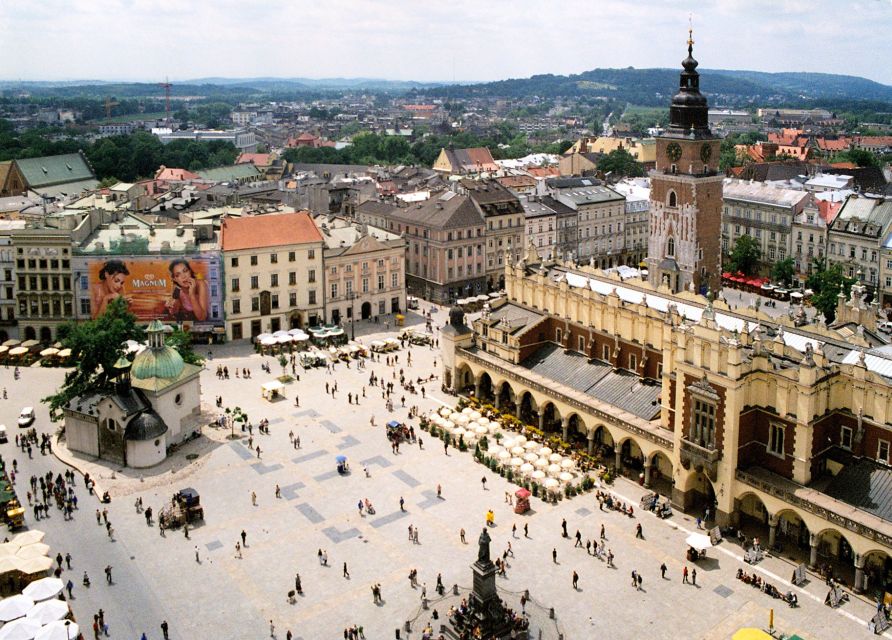
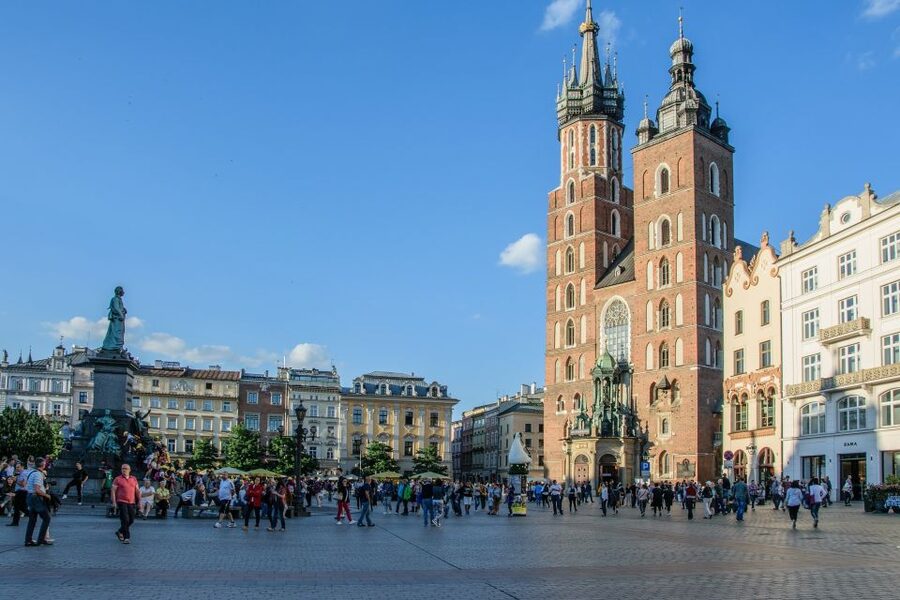
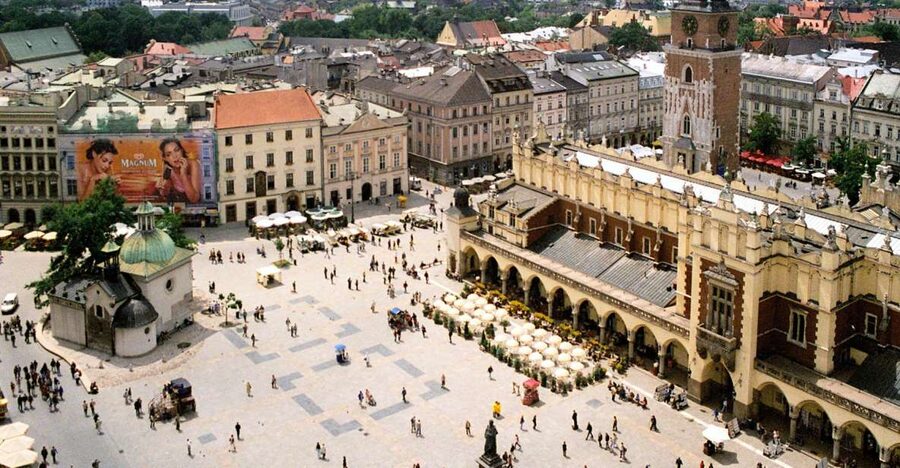
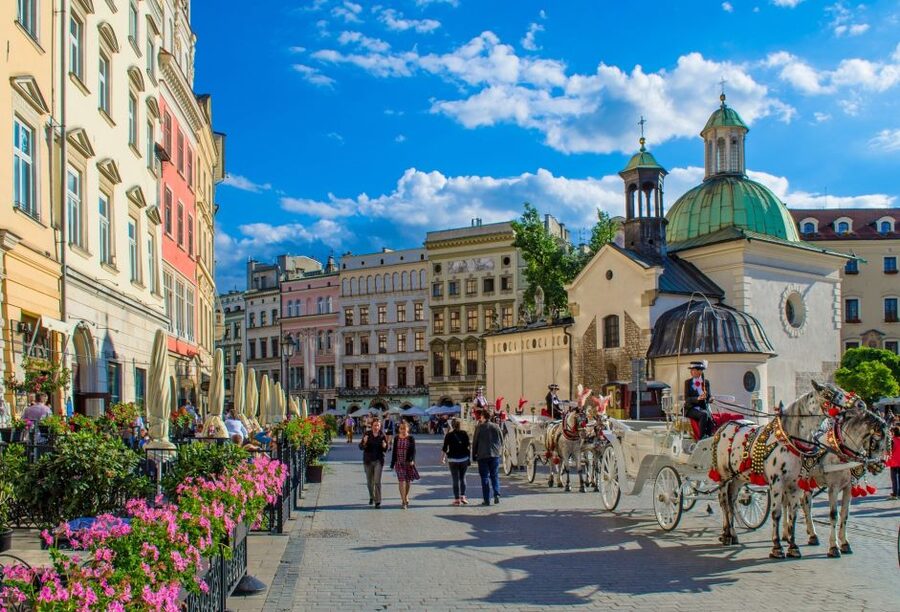
Krakow’s Main Market Square is the natural center of this tour. It is large enough to make the surrounding buildings feel theatrical, but the guide gives the space a human scale by pointing out how trade, worship, politics, and daily life met here.
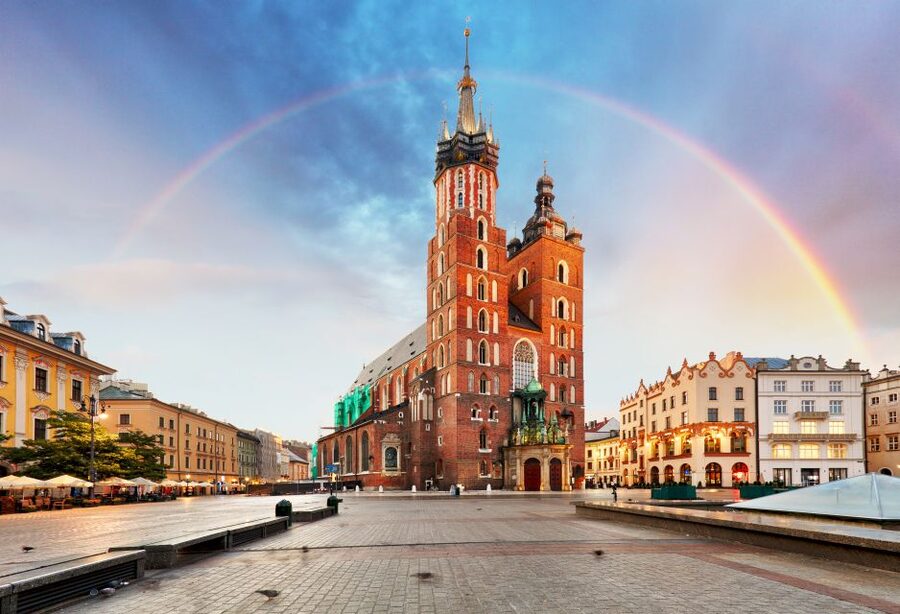
St. Mary’s Basilica is one of the key stops. You primarily admire its Gothic exterior, with its tall uneven towers and detailed brickwork. The basilica is not just a photo stop. It reflects the importance of religion and civic identity in medieval Krakow, and your guide can connect the building to the city’s wider story.
The tour description does not promise a full interior visit to every monument. That matters. Museum or attraction entrance fees are not included unless specifically stated, so ask your guide what access is included on the day. You should not assume that every landmark becomes an extended indoor visit.
The private format helps here. If you want to know why the two towers differ, how the square functioned as a trading center, or how religious buildings survived Krakow’s changing political eras, you can ask without waiting for a whole group.
The Cloth Hall and Krakow’s trading past
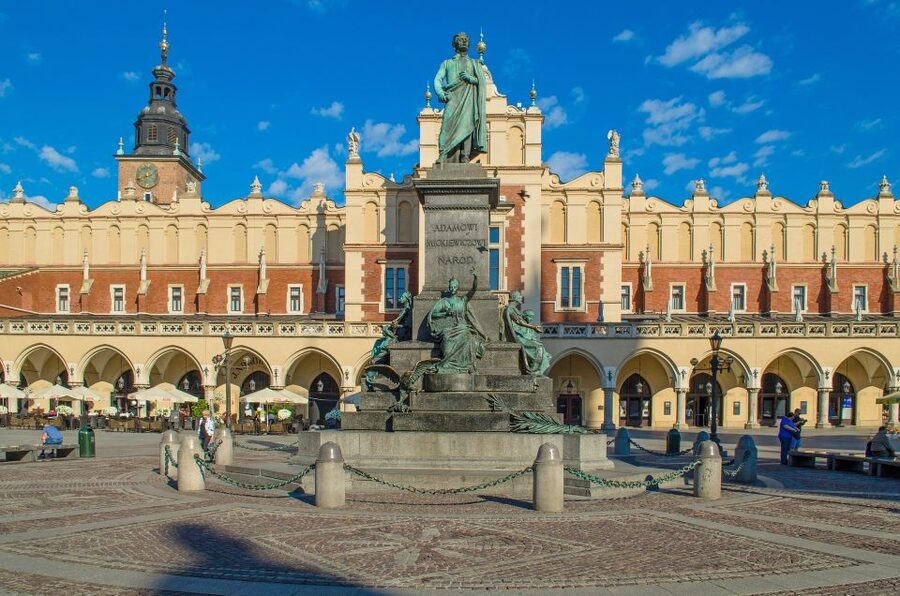
In the middle of the Main Market Square, the Cloth Hall gives the tour one of its clearest links to old commerce. Its decorative exterior and long arcade recall a time when merchants came to Krakow to barter goods and discuss business.
Today, it is easy to see the building as an attractive backdrop. A good guide makes you picture its purpose instead: Krakow was not simply a royal and religious center, but also a place where long-distance trade shaped public life.
I especially like this part for visitors who want context rather than a checklist of facades. The guide can explain how the square worked as a shared civic room, with commerce, ceremony, and local routines all taking place within a few steps of one another.
The stop is also useful for deciding how much shopping time you want later. The focus here is on the building and its role in the city, not on turning the tour into a market visit.
Jagiellonian University and the Royal Route
The walk continues past Jagiellonian University, one of the world’s oldest universities. Its presence adds another layer to Krakow’s identity. This was not only a city of monarchs and merchants, but also a place shaped by education and intellectual life.
From here, the Royal Route leads toward Wawel Hill. The route gives the walk a strong sense of direction. You are not zigzagging between unrelated attractions. You are following the historic path from the Old Town toward the seat of Polish royal power.
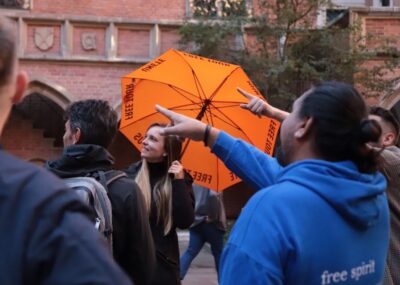
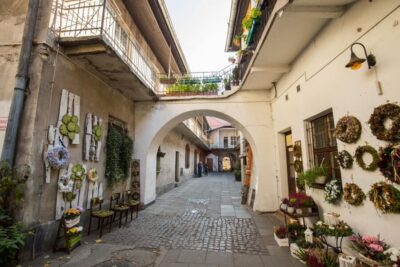
This is where a private guide can be more useful than a self-guided walk. You can learn how the landmarks connect, rather than collecting isolated dates. You might also hear small local details about streets, courtyards, and everyday habits that are easy to miss when you move quickly with a map.
The tour promises some quieter and special places that you may not find alone. The exact stops depend on the selected option and the guide, so I would see this as a welcome possibility rather than a fixed promise of secret locations.
A few more Krakow trips worth comparing
- Krakow Airport Private Transfer
★ 5.0 · 2,227 reviews - Private Departure Transfer: Krakow City To Krakow Airport Balice
★ 4.5 · 367 reviews - Skip-the-Line Wawel Castle Chambers Private Tour
★ 4.7 · 262 reviews - Legendary Private Nowa Huta Communism Tour with Crazy Guides
★ 5.0 · 262 reviews
Wawel Hill, courtyards, and royal power
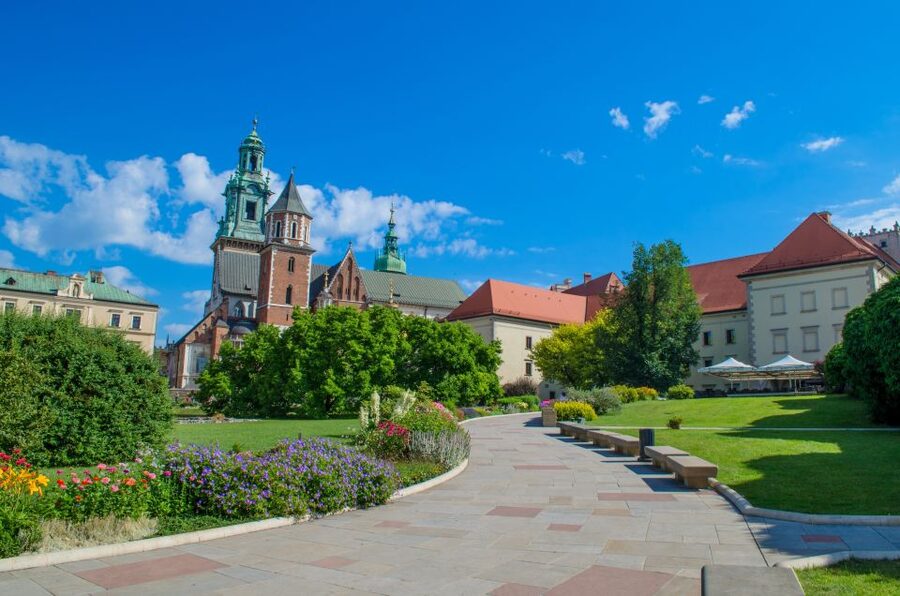
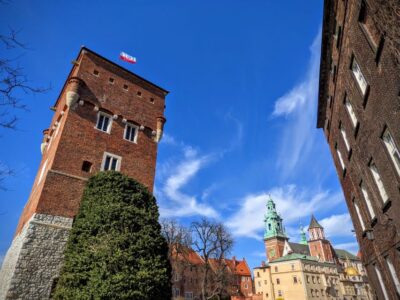
Wawel Hill is the grand finish to the four-hour route. The architectural complex includes churches, Renaissance buildings, courtyards, and Wawel Castle, the former royal residence.
The setting matters as much as any single building. After the commercial energy of the Main Market Square, Wawel feels like a statement of power. The hill gathers royal, religious, and national symbolism in one place, making it the point where Krakow’s medieval and modern identities meet.
The tour includes Wawel Hill and its courtyards. You can expect the guide to explain the role of Wawel Castle and how the hill developed over centuries. The walk is not presented as a full castle museum visit, and optional museum entrance fees are not included. If you want to see specific castle interiors, confirm the plan before you arrive.
That distinction can save disappointment. A walking tour of Wawel gives you the setting, architecture, and major historical connections. A museum visit requires more time and may need a separate ticket or visit.
Inside Wawel Cathedral
Wawel Cathedral is one of the most meaningful stops because it served as the place where Polish kings were crowned and laid to rest. Its importance is political as well as religious. The cathedral helps explain why Wawel remained central even after royal power moved away from Krakow.
The experience includes a look inside the cathedral, but entrance arrangements can depend on the selected option and current access. Since general museum fees are listed as optional, ask what is covered before you count on a full interior visit.
Give yourself time to listen here. The cathedral’s value is not only in decoration. It is where the story of monarchy, national memory, and Catholic Poland comes together. A guide can make the tombs and chapels more meaningful than they would be on a quick walk past the doors.
For many people, this is the emotional high point of the shorter tour. The Main Market Square is more lively and instantly photogenic, but Wawel Cathedral carries the heavier historical weight.
The modern story of Krakow
Many Old Town walks stop once the medieval monuments have been covered. This experience tries to go further by discussing World War II, the Polish People’s Republic, and Krakow today.
That is one of its best ideas. Krakow is often reduced to kings, churches, and attractive stone streets, but its recent past explains much about the city you see now. The guide’s modern section gives you a chance to understand how Krakow moved through wartime trauma, communist rule, and the changes of contemporary Poland.
You also get an introduction to everyday local life. The information provided promises a look at how people live now and what Krakow is known for, alongside the city’s business centers and growing tourism.
I would not expect a full political history course in four hours. You will get an overview woven into the walk, with room to ask about the periods that interest you most. If twentieth-century history is your main reason for coming, you may want a separate museum visit rather than relying on this tour alone.
The broader view does make the experience more useful for a first day in Krakow. You leave with a better sense of how the postcard city and the working city fit together.
Choosing the six-hour Kazimierz extension
The six-hour version adds Kazimierz, Krakow’s historic Jewish quarter. This is not a minor extra neighborhood. Kazimierz has its own religious, cultural, and wartime story, and it has become a major part of Krakow’s cultural life.
The extended route includes tickets to Tempel Synagogue. The synagogue is closed to the public on Saturdays and Jewish holidays. When that happens, the replacement is a ticket to the Tadeusz Pankiewicz Pharmacy in Kazimierz District.
That substitution changes the focus. Tempel Synagogue offers a religious and architectural perspective, while the pharmacy connects to Krakow’s wartime Jewish history. Both are worthwhile, but they are not interchangeable experiences. Check the date of your visit if the synagogue is important to you.
You should also think about stamina. Six hours on foot gives you a much broader picture, but it can be tiring. One useful strategy is to choose the four-hour Old Town and Wawel walk first, then visit Kazimierz and other museums separately. That keeps each outing focused and gives you more time in places that deserve attention.
The extended option suits you best if you want one guide to connect royal Krakow, Jewish Krakow, wartime history, and modern culture. The shorter version is better if your schedule is tight or you prefer a less demanding morning or afternoon.
Guide quality and the private-tour tradeoff
A private walk gives you direct access to the guide, and the language choice is unusually broad. The available languages are English, Spanish, French, German, Italian, Polish, and Russian.
Past experiences point to strong performances from guides such as Anna, who explained both old and new Krakow clearly, added anecdotes, and showed real affection for the city. French-speaking guides have also been praised for clear explanations and strong command of the subject.
Still, the experience can depend heavily on the individual guide. One less successful account described a slower route, fewer sights, poor jokes, and an impatient attitude toward photography. That does not define every departure, but it is a useful reminder that a private tour is shaped by the person leading it.
You can help the day along by telling the guide what matters most. If you want more time for photographs, ask early. If modern history interests you more than architectural detail, say so. The private setting gives the guide room to adjust, though the main route and available time still set limits.
There has also been an account of a delayed start caused by a cancellation misunderstanding, followed by a replacement guide arranged in less than half an hour. I would keep the meeting details and the provider’s contact information available, especially on a Sunday morning or during a busy season.
Is $137 per person good value?
At $137 per person, this is not the cheapest way to see Krakow. The value depends on your group size and how much you want from the guide.
For one or two people, the price buys a dedicated guide, a four-hour route, language support, and a focused introduction to the city’s major sights. That can be worthwhile if you want questions answered and do not want to follow a large group at someone else’s pace.
For a larger private party, the cost may compare more favorably with several individual tickets and separate guiding. The six-hour option adds Kazimierz and Tempel Synagogue, which gives the longer version more value if you already know you want Jewish Krakow included.
The price does not cover optional museum entrance fees, and that is the main budget point to watch. You are paying primarily for the guide and the walking experience, not a package of every possible interior.
I would book it for a first visit when you want orientation, history, and local context in one appointment. If you mainly want to enter museums or spend long periods inside Wawel Castle, plan extra visits and extra costs.
Practical details for a smoother walk
Book a start time that leaves you alert. Four hours of walking, listening, and standing can feel longer than four hours on a sightseeing bus.
Check your email the day before for the meeting instructions. If you are staying in the Old Town, provide your full address so pickup can be considered. Otherwise, go directly to the Barbakan Krakowski meeting point.
The tour is wheelchair accessible, but contact the provider if you have specific mobility needs. The route includes historic areas, courtyards, and extended outdoor walking, so the practical experience may still vary with weather and access conditions.
Bring water and dress for the forecast. Rain and snow have made the walk feel long in the past, and Krakow’s open squares offer limited shelter while a guide is speaking.
If you like taking photographs, tell the guide at the start. The tour covers many major sights, and a little coordination can prevent you from feeling rushed.
Who should book this Krakow walk?
I would recommend the four-hour version to first-time visitors who want a clear introduction to Krakow without spending a full day on one activity. It suits couples, families, and small private groups who value conversation and flexibility.
It is also a good choice if you want more than medieval architecture. The discussion of World War II, communist Poland, and contemporary Krakow gives the city a wider frame.
Choose six hours if Kazimierz is high on your list and you want Tempel Synagogue included. Choose a separate visit instead if you prefer slow museum time, long meals, or independent wandering through the Jewish quarter.
The tour is less suitable if you dislike extended walking, need a very relaxed pace, or want guaranteed access to every interior. In those cases, a shorter private visit with fewer stops may serve you better.
Should you book the Highlights of Old and New Town tour?
Book it if you want Krakow’s essential sights tied together by a private guide, with modern history added to the usual royal and religious story. The route is well chosen: Main Market Square, St. Mary’s Basilica, the Cloth Hall, Jagiellonian University, Wawel Hill, and Wawel Cathedral form a strong first look at the city.
I would choose the six-hour version only when Kazimierz is a priority and you have the energy for a full day on foot. Otherwise, the four-hour tour gives you a solid foundation, and you can return later for museums, Jewish heritage sites, or a slower afternoon in the city.
The high 4.9 score from 11 ratings fits the strongest parts of the experience, especially the clear explanations, language options, and guides who bring Krakow to life. The mixed account about guide manner and pace means you should communicate your interests and photography needs early. For most first-time visitors, the private format and broad historical range make $137 a reasonable price for a well-planned introduction.
FAQ
How long is the Krakow Old Town and Wawel tour?
The main tour lasts four hours. A six-hour version is available and adds Kazimierz, Krakow’s historic Jewish quarter.
What sights are included in the four-hour tour?
The route includes Little Market Square, the Main Market Square, St. Mary’s Basilica, the Cloth Hall, Jagiellonian University, Wawel Hill, Wawel Castle courtyards, and Wawel Cathedral.
Is the tour private?
Yes. The experience includes a private walking tour with a five-star licensed guide who speaks your selected language.
Which languages are available?
You can choose English, Spanish, French, German, Italian, Polish, or Russian.
Does the tour include hotel pickup?
Pickup is available for accommodations in Krakow’s Old Town when you provide the full address. If your accommodation is more than 1.5 kilometers from the meeting point, you meet in front of the Barbakan Krakowski.
Does the six-hour tour include Kazimierz and Tempel Synagogue?
Yes. The six-hour option includes a Kazimierz tour and tickets to Tempel Synagogue. The synagogue is closed on Saturdays and Jewish holidays, when it may be replaced by a ticket to the Tadeusz Pankiewicz Pharmacy.
Are museum entrance fees included?
Optional museum entrance fees are not included. Confirm any desired interior visits with the guide before the tour.
Just added around Krakow
- Private Guided Tour: Oskar Schindler’s Factory★ 5.0 · 3 reviews
- E-Scooter Krakow sightseeing tour★ 5.0 · 3 reviews
- From Krakow: Zakopane and Thermal Pools Guided Trip★ 5.0 · 3 reviews
- Schindler’s Factory, Ghetto and Plaszow Camp Guided Tour★ 4.7 · 3 reviews
- Krakow: River Cruise & Guided Visit to Former Plaszow Camp★ 3.6 · 3 reviews
- From Krakow: Private Wieliczka Salt Mine Tour★ 4.0 · 3 reviews
- Kraków: Private Hot Air Balloon Flight with Champagne★ 3.7 · 3 reviews
- Krakow: Old Town short walk with St. Mary’s Basilica visit★ 5.0 · 3 reviews
Walking Tours, compared.
Old Town & Wawel Castle Walking Tour in English
Read our review →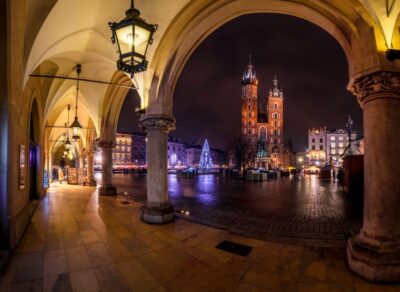
Browse the lists this tour appears in