
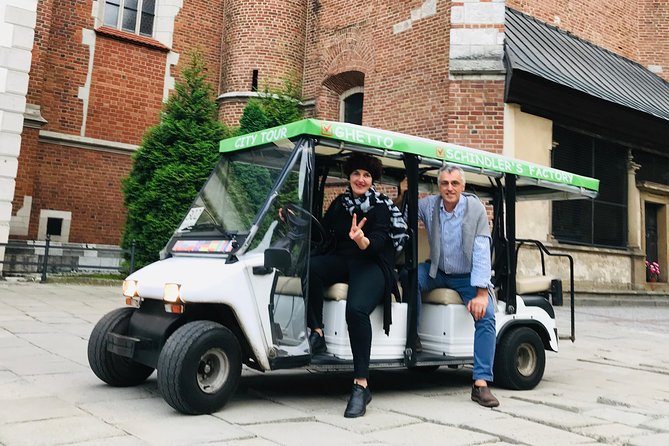
Reviewed · GOLF CART TOURS
The best view of Krakow from Golf Cars
Krakow is easiest to understand when you connect its royal centre with Kazimierz and Podgórze. This electric golf-cart tour does that neatly, taking you through streets too narrow or awkward for a large sightseeing bus. In about two hours, you see Wawel Castle, the Vistula River, Jewish Kazimierz, the former ghetto, and several important churches and synagogues.
I like the small maximum of seven people, which gives the driver room to answer questions and pause for photos. I also like the mix of live English commentary and an audio guide in 26 languages, a useful setup when members of your group prefer different languages. The main caution is reliability: two bookings were reported as no-shows, so I would confirm the meeting details before setting out.
In This Review
- Key points at a glance
- Why a golf cart works well in Krakow
- From Matejki Square to Krakow’s medieval centre
- Wawel Hill, the dragon, and royal Poland
- Churches at the foot of the hill
- Kazimierz’s synagogues and Szeroka Street
- Old Synagogue, Remuh, and the life of the district
- Podgórze and the memory of the Krakow ghetto
- Audio, guides, weather, and the real-world details
- Who gets the best value from this tour
- Should you book the Krakow golf-cart tour?
- FAQ
- How long is the golf-cart tour?
- Where does the tour start?
- Where does the tour finish?
- How many people can join the group?
- Is pickup available?
- Is the tour conducted in English?
- Are admission tickets included?
- Is food or drink included?
- Can the tour operate in cold or rainy weather?
- What is the cancellation policy?
Key points at a glance
- A compact route with a wide reach: Cover the Old Town, Wawel, Kazimierz, and Podgórze without making the full journey on foot.
- Maximum seven people: The small vehicle feels more personal than a standard city bus.
- Strong history focus: Hear about Polish kings, medieval battles, Jewish Krakow, and the Nazi-created ghetto.
- Useful language choice: Audio commentary is available in 26 languages, while the driver speaks English.
- Several short photo stops: The Wawel Dragon, Church on the Rock, Corpus Christi Church, and ghetto memorial area receive roughly 5 to 10 minutes each.
- Good value for a group: At $103.03 for up to seven people, the cost works best when shared by several passengers.
Why a golf cart works well in Krakow
The appeal here is not speed. It is access.
A large coach needs broad roads and clear turning space. An electric golf cart can slip along smaller streets near the Old Town and Kazimierz, bringing you closer to the places that give Krakow its character. You will still need to get out and walk briefly at some stops, but the vehicle saves your legs and links districts that are spread across the centre.
This format also suits a first visit. Krakow has several historic areas that can blur together on a map. The tour gives you a quick framework: medieval Krakow around the Old Town, royal Poland at Wawel, Jewish life in Kazimierz, and the wartime story of Podgórze.
The vehicle carries no more than seven people. That matters because the driver can explain what you are seeing without trying to address a packed bus. A small group also makes photo stops easier. On the other hand, the cart is not a private luxury vehicle. You are booking a group experience unless your party fills it.
The advertised price is $103.03 per group of up to seven. For one person, that is expensive. For six or seven people, it becomes a sensible way to get a private-feeling city overview without paying for several separate taxis or a full private guide. The value depends heavily on your group size.
More golf cart tours of Krakow:
- Krakow: City Sightseeing Tour by Electric Golf Cart
★ 4.5 · 3,264 reviews - Krakow: City Sightseeing Tour Eco Electric Buggy Golf Cart
★ 4.7 · 3,143 reviews - Krakow: Extended City Sightseeing Tour – Eco Buggy Golf Cart
★ 4.7 · 794 reviews
From Matejki Square to Krakow’s medieval centre
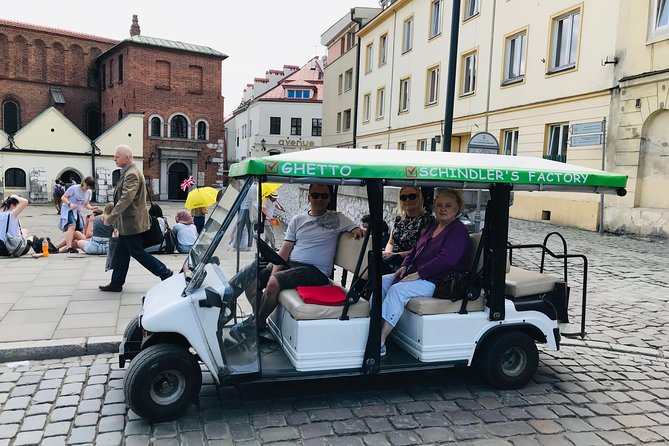
The stated meeting point is plac Jana Matejki 2, near public transportation. The tour returns there after roughly two hours, which makes it easy to continue sightseeing in the Old Town afterward.
The opening section focuses on Krakow’s medieval core. One early landmark is the historic gateway built around 1498, a reminder that the Old Town was once enclosed and carefully controlled. The route also reaches the Grunwald Monument, a major symbol of Polish national pride.
The monument commemorates the Battle of Grunwald, fought in 1410 between the forces of Poland and Lithuania and the Teutonic Knights. It was one of medieval Europe’s largest battles. You do not need to know every detail of the conflict to appreciate the monument. Its scale and national importance make it a useful introduction to Poland’s long memory of military victories.
Next comes Planty, the large park that circles the Old Town. It follows the line of the medieval defensive walls, most of which disappeared in the early 19th century. From the cart, you get a quick sense of how compact the old city was behind its fortifications.
This is one place where the golf cart has a clear advantage over a long walking route. You can see the broad shape of the old centre, then continue toward Wawel without spending your first hour navigating every side street.
Wawel Hill, the dragon, and royal Poland
Wawel Castle is the tour’s grandest landmark. For centuries it served as the home of Poland’s kings and became a national symbol. Today, it houses one of Poland’s major art museums and forms part of Krakow’s UNESCO-listed Historic Centre.
The cart does not include admission to the castle interiors, so treat this stop as an outside introduction rather than a museum visit. That is useful if you have limited time, but you should plan a separate visit if royal apartments, art collections, or cathedral interiors are high on your list.
At the foot of Wawel Hill, the route pauses at the Wawel Dragon Monument for about 10 minutes. The dragon belongs to one of Poland’s best-known legends, said to have lived in a cave beside the Vistula River. This is a lighter stop after the castle’s political history, and it gives you time for photos.
The nearby Bernardine Church dates from the second half of the 17th century in its present form. Another baroque church on the route was built between 1719 and 1728. The short explanations here help show how Krakow’s religious buildings changed over time, from medieval foundations to later baroque decoration.
Churches at the foot of the hill
The Church on the Rock, or Kosciol na Skalce, receives about 10 minutes. A Gothic church occupied this site after King Casimir III rebuilt it, and since 1472 the shrine has belonged to the Pauline Fathers. Its current interior gained baroque decoration between 1733 and 1751.
This is one of the stops where the audio system can help. You can listen in your preferred language while taking in the exterior and surroundings. Admission is not included, so the tour does not replace a proper church visit.
The route then enters Kazimierz, Krakow’s historic Jewish quarter. Wolnica Square was part of the old market square and gives you a sense of the district’s former civic life. Kazimierz is not presented as a single museum piece. Churches, synagogues, market spaces, and residential streets sit close together, reflecting the area’s mixed past.
The Father Bernatek Footbridge crosses the Vistula and links Kazimierz with Podgórze. The tour allows about five minutes here. That is enough for a quick look and photographs, but not enough for a long river walk. If you want to explore the bridge or its surrounding districts at leisure, return later on foot.
A different sort of day out from Krakow:
- From Krakow: Auschwitz-Birkenau Guided Tour & Hotel Pickup
★ 4.5 · 33,358 reviews - From Krakow: Auschwitz-Birkenau Guided Tour & Hotel Pickup
★ 4.5 · 29,340 reviews - Krakow: Auschwitz Guided Tour with Optional Hotel Pickup
★ 4.5 · 15,280 reviews - Krakow–Zakopane: Cable Car, Chocholow Baths, Cheese & Vodka
★ 5.0 · 10,720 reviews
Kazimierz’s synagogues and Szeroka Street
The strongest part of the route is probably the time spent among Kazimierz’s Jewish landmarks. The tour visits Corpus Christi Church first, a Gothic church founded by King Casimir III in 1335. Its interior combines Polish Gothic forms with impressive baroque decoration.
That pairing is important. Kazimierz’s story includes both Catholic and Jewish communities, and this route places their buildings within the same urban setting rather than treating them as separate subjects.
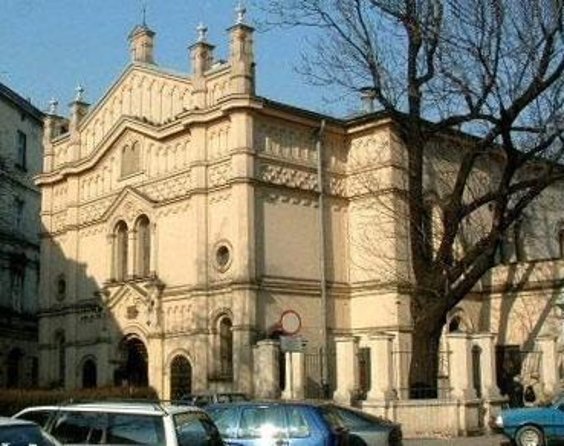
Tempel Synagogue, built in the 1860s, represents the progressive Jewish community. The visit is listed as a five-minute stop, and admission is not included. You will mainly get an exterior look and an explanation rather than a full interior tour.
The route continues past several synagogues from different periods. One dates from the 1640s and suffered severe damage during the German occupation. Another was founded in the 1530s. The High Synagogue was the third synagogue built in the former Jewish city.
These brief stops work best as a connected lesson. You see how the community expanded, worshiped, and shaped the district over several centuries. You will not have time to examine every facade in detail, so anyone especially interested in Jewish heritage should use the tour as an orientation and return independently.
Szeroka Street receives about 10 minutes and is described as the heart of the Jewish district. It is a good place to slow down, look at the surrounding buildings, and understand the scale of historic Kazimierz.
Old Synagogue, Remuh, and the life of the district
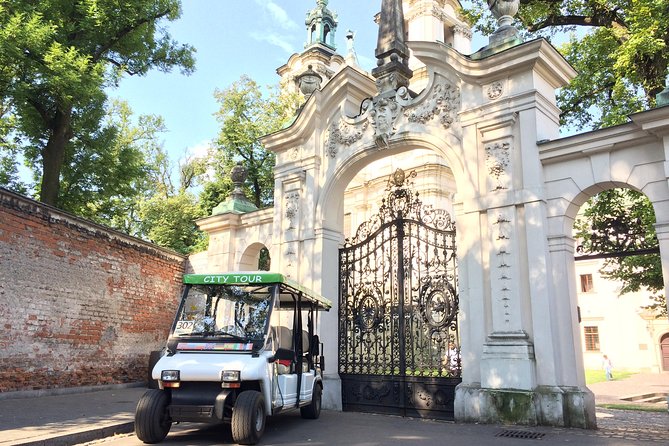
The route reaches the Old Synagogue, now part of the Krakow Museum. It is described as the oldest synagogue in the city, dating to either 1407 or 1492. Inside, a permanent exhibition presents objects from the museum’s Judaica collection.
Admission is not included. The 10-minute stop gives you a clear choice: stay with the group for the outside explanation, or plan a later return if you want time in the exhibition. I prefer the latter for anyone with a serious interest in the district, since museum displays reward a slower pace.
You also pass a synagogue built in the 1620s, now used as a branch of a cultural centre. During the Jewish Culture Festival, it hosts workshops and lectures. The route points out the house where Helena Rubinstein was born, another small detail that connects an ordinary street to a well-known international name.
Remuh Synagogue receives another 10-minute stop. Its complex of Jewish architecture and sacred art dates to the mid-16th century and remains connected with religious life. As with the other synagogues, admission is not included.
I like this section because it moves beyond a list of famous buildings. You get a sense of a functioning neighborhood, its markets, worship spaces, cultural institutions, and personal stories. The limitation is the clock. Ten minutes is enough to hear the basics and take photographs, not enough for a reflective visit to every site.
Podgórze and the memory of the Krakow ghetto
The final section crosses into Podgórze and reaches Plac Bohaterów Getta, the main memorial square connected with the Krakow ghetto created by Nazi Germany. The ghetto was one of five major metropolitan Jewish ghettos created by the Nazi regime.
The tour gives this stop about five minutes. That is brief for a place carrying such painful history, so I would approach it with care and avoid treating it as just another photo stop. The guide’s explanation and the audio commentary can provide basic context, but you may want to return later for a longer visit.
The route also points out the only pharmacy in the Krakow ghetto, now a museum with an exhibition. You pass a surviving fragment of the ghetto wall on Lwowska Street and the former entrance area at the beginning of Limanowskiego Street, near Podgórze Market Square.
These details give physical shape to events that can otherwise feel distant. A wall fragment, a pharmacy, and an entry point are easier to place in your mind than a date alone. Still, admission to the pharmacy museum is not included, and the short schedule means you will not tour it during this experience.
The last listed stop is the Church of St. Joseph at Podgórski Square, a 20th-century church visited for about five minutes. From there, the route returns to the meeting point.
Audio, guides, weather, and the real-world details
The tour includes an English-speaking driver and an audio guide system in 26 languages. That arrangement has an important practical benefit: you can hear structured commentary in your own language while still asking the driver questions in English.
A review identifies the driver as Mikhal and praises his friendly manner, safe driving, English explanations, and willingness to provide facts. Another account describes an Italian audio version working well, with the driver adding further information in English and helping with questions, photos, and stops. The provider is listed as Michal Urban, so names may appear differently at booking.
The cart has covers for cold and rainy days, and city tours can operate in such weather. However, the cancellation terms say the experience requires good weather. If poor conditions cause cancellation, you should be offered another date or a full refund.
The experience requires a minimum number of participants. If that minimum is not reached, the operator should offer another option or a full refund. You receive confirmation at booking, and free cancellation is available until 24 hours before the start time. Changes or cancellations inside that 24-hour window are not refundable.
The most serious practical warning is the reported no-show problem. Two separate complaints describe golf carts failing to arrive for bookings, including a group of eight that had reserved two carts. The overall rating is 3.7 from 11 reviews, with several excellent reports but also these two very poor experiences.
I would not ignore that warning. Confirm the meeting point and start time with the provider before the day of the tour. Arrive at plac Jana Matejki 2 with enough time to identify the vehicle, and keep your booking confirmation available. This does not prove every booking will fail, but it is a sensible safeguard.
Who gets the best value from this tour
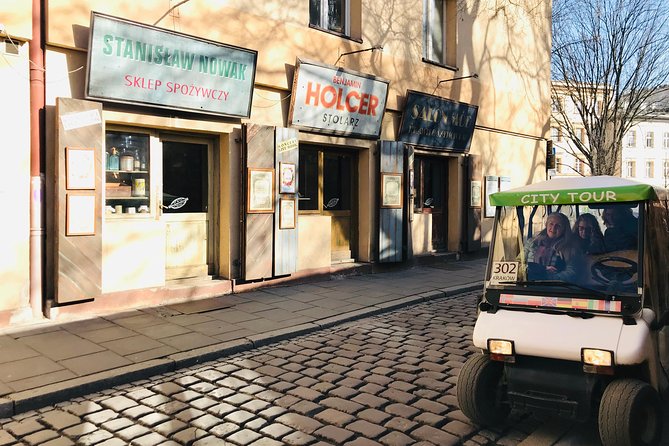
I would recommend this experience to a group that wants a broad introduction without committing to a long walking tour. Families, older visitors, and people with limited time may appreciate the vehicle and the frequent short stops.
It also suits a group with mixed interests. One person can focus on royal Krakow, another on churches, another on Jewish heritage, and everyone gets a useful first look at the city’s major districts.
The tour is less suitable if you want long interior visits, a slow photography outing, or a detailed study of every synagogue. Many stops last only five or 10 minutes, and several admission tickets are not included. Think of it as a guided overview and orientation, not a replacement for Krakow’s museums.
At $103.03 per group, the price is fair when divided among a full group of up to seven. It is harder to justify for one or two people, especially if you are comfortable walking and can arrange your own visits. The value improves if saving time and energy matters more than exploring each site at length.
Should you book the Krakow golf-cart tour?
Book it if you want to connect Krakow’s main historic areas in two hours, prefer a small vehicle to a large bus, and value live help with photos and questions. The route covers an unusually broad range, from the medieval gateway and Grunwald Monument to Wawel, Kazimierz, and the former ghetto.
Skip it if you want guaranteed museum entry, long stops, or a fully private guide. I would also book with a clear confirmation plan because the two reported no-shows are a genuine concern.
For a full group, this is a practical first-day orientation. Afterward, return on foot to Wawel Castle, the Old Synagogue, Remuh Synagogue, or the ghetto pharmacy, giving the places that matter most to you the time they deserve.
FAQ
How long is the golf-cart tour?
The tour lasts approximately two hours.
Where does the tour start?
It starts at plac Jana Matejki 2, 31-157 Kraków, Poland.
Where does the tour finish?
The tour ends back at the meeting point.
How many people can join the group?
The vehicle accepts a maximum of seven travelers, and the listed price is for a group of one to seven people.
Is pickup available?
Pickup is offered, although the stated meeting point is plac Jana Matejki 2.
Is the tour conducted in English?
The driver speaks English. An audio guide is also available in 26 languages.
Are admission tickets included?
Admission tickets are not included for Tempel Synagogue, the Old Synagogue museum, or Remuh Synagogue. Several other listed stops are free.
Is food or drink included?
No. Food and drinks are not included.
Can the tour operate in cold or rainy weather?
The vehicles have special covers for cold and rainy days. The experience still requires good weather, and poor-weather cancellations may result in another date or a full refund.
What is the cancellation policy?
You can cancel at least 24 hours before the start time for a full refund. Cancellations or changes made less than 24 hours before the start time are not accepted for a refund.
Just added around Krakow
- Private Guided Tour: Oskar Schindler’s Factory★ 5.0 · 3 reviews
- E-Scooter Krakow sightseeing tour★ 5.0 · 3 reviews
- Schindler’s Factory, Ghetto and Plaszow Camp Guided Tour★ 4.7 · 3 reviews
- From Krakow: Zakopane and Thermal Pools Guided Trip★ 5.0 · 3 reviews
- Kraków: Private Hot Air Balloon Flight with Champagne★ 3.7 · 3 reviews
- Krakow: River Cruise & Guided Visit to Former Plaszow Camp★ 3.6 · 3 reviews
- From Krakow: Private Wieliczka Salt Mine Tour★ 4.0 · 3 reviews
- Krakow: Old Town short walk with St. Mary’s Basilica visit★ 5.0 · 3 reviews
Golf Cart Tours, compared.
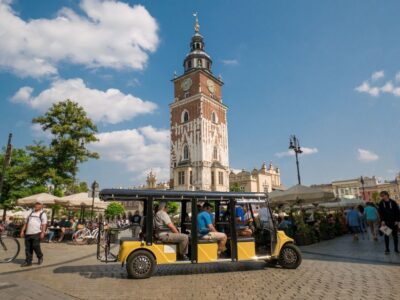
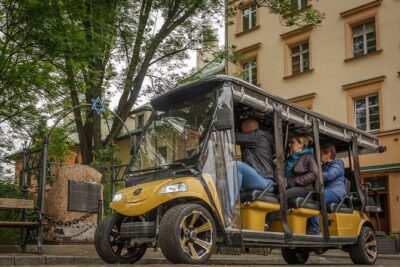
City Sightseeing Tour Eco Electric Buggy Golf Cart
Read our review →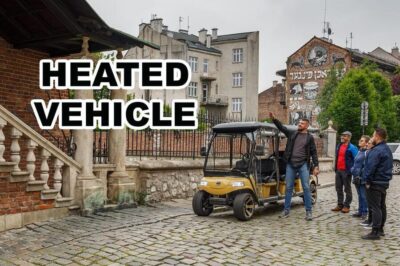
Extended City Sightseeing Tour – Eco Buggy Golf Cart
Read our review →
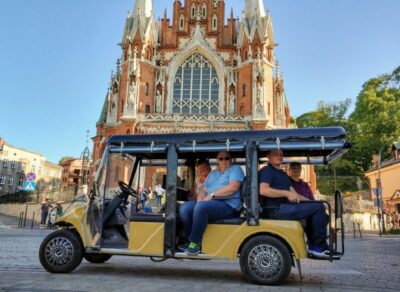
Jewish Quarter and Ghetto Electric Golf Cart Tour
Read our review →City Sightseeing Tour Eco Electric Buggy Golf Cart
Read our review →
Krakow Grand City Tour by golf cart – All 3 districts
Read our review →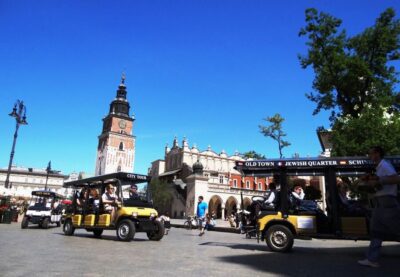
Browse the lists this tour appears in