
Reviewed · KRAKÓW
WOMAI Cracow – Into the darkness experience
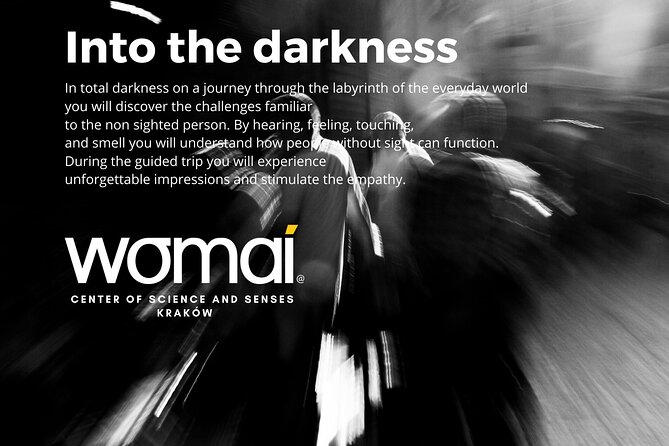
The unusual part comes at once: you enter a world with no light at all, then try to make sense of ordinary situations without sight. A blind guide leads you through the experience, giving you a direct, respectful look at how much work your other senses can do.
I like two things here. The guide brings lived experience, not just a prepared script. I also like the practical ending, when you can ask questions and get an introduction to Braille rather than simply walking out after the darkness.
The main drawback is that total darkness can be demanding. This is not a good choice if you have severe claustrophobia, major mobility limits, or hearing problems, and you should expect to rely on the guide and your group for much of the hour.
In This Review
- Key points to know before you book
- What WOMAI Krakow asks you to do without sight
- Why the blind guide matters
- The one-hour route through unfamiliar daily tasks
- What the darkness feels like in practice
- The Braille lesson gives the visit a useful finish
- Price, timing, and the value of an hour in Krakow
- Who will get the most from Into the Darkness
- Practical points before you arrive
- Is WOMAI Into the Darkness worth booking?
- FAQ
- Where does the Into the Darkness experience take place?
- How long does the experience last?
- How much does it cost?
- Is the experience offered in English?
- Is the activity near public transportation?
- Is the experience suitable for people with hearing problems?
- Is the activity suitable for people with mobility disabilities or claustrophobia?
- Can I cancel for a full refund?
Key points to know before you book
- Total darkness changes familiar tasks: You use sound, touch, smell, and balance instead of sight.
- A blind guide leads the experience: The encounter offers personal insight into daily life without vision.
- The visit lasts about one hour: It fits neatly into a Krakow sightseeing day.
- Braille is part of the learning: You have time to ask questions and discover how the writing system works.
- The price is $17.33 per person: That is a modest cost for an unusual, thoughtful indoor activity.
- Some limits matter: Moderate fitness is advised, and the experience is not recommended for hearing problems, major mobility disabilities, or severe claustrophobia.
What WOMAI Krakow asks you to do without sight

Most Krakow sightseeing depends on your eyes. You look at church interiors, read museum labels, admire old streets, and check a map when you lose your way. WOMAI’s Into the Darkness experience turns that habit around for roughly an hour.
You enter complete darkness and deal with familiar situations using your other senses. The point is not a spooky trick or a haunted-house scare. It is a controlled attempt to show how much your daily routine depends on sight, and how quickly that routine becomes uncertain when vision disappears.
You may feel oddly cut off from the person or object in front of you. One account of the experience describes moments when the participant could not feel the person or object ahead, creating a strong sense of being alone even while part of a guided group. That detail gives you a useful idea of the challenge: darkness here affects your sense of space, distance, and confidence, not just your ability to see.
The experience is led by a blind guide. That makes the visit more than a sensory exercise. You are not simply asked to guess what life without sight might be like. You also have the chance to hear explanations from someone who understands the subject personally.
Other Krakow trips people book alongside this one:
- From Krakow: Auschwitz-Birkenau Guided Tour & Hotel Pickup
★ 4.5 · 33,358 reviews - From Krakow: Auschwitz-Birkenau Guided Tour & Hotel Pickup
★ 4.5 · 29,340 reviews - Krakow: Auschwitz Guided Tour with Optional Hotel Pickup
★ 4.5 · 15,280 reviews
Why the blind guide matters
A guide in a dark room must do more than point out objects. Clear instructions, calm pacing, and a good sense of when to let you work things out yourself all matter. The supplied information does not give the guides’ names, so I cannot identify them personally, but it does make clear that a blind guide leads the session.
That arrangement changes the tone. You are the person adapting to an unfamiliar setting, while the guide is the person who knows how to move through it. The experience can quietly reverse the usual balance between sighted visitor and local expert.
You also get time to ask questions. Use it. The most useful part may come after the practical tasks, when you can discuss how Braille works and ask about the guide’s own perspective. The Braille lesson gives the session a clear educational finish and helps connect the dark-room challenge to a real communication system.
I appreciate this balance. The visit is experiential, but it does not stop at a quick emotional reaction. It gives you a small amount of context and a chance to think about how blind and partially sighted people handle ordinary parts of the day.
The one-hour route through unfamiliar daily tasks
The experience has one main stop at WOMAI Krakow, with the dark-room session forming the heart of the visit. The exact sequence of tasks is not specified, so you should not arrive expecting a named list of rooms or activities. Instead, expect a guided progression through everyday situations in complete darkness.
That uncertainty is part of the design. You cannot scan the room ahead of time or plan your route by sight. You listen for instructions, reach out carefully, judge surfaces by touch, and try to remember where people are positioned around you.
The task is not about speed. You may find that simple actions require more thought than expected. You might focus on the direction of a voice, the position of an object, or the distance between yourself and something you need to touch. Your other senses become more important, but they do not instantly replace vision.
This is where the hour earns its keep. At $17.33 per person, you are paying for an unusual guided activity rather than another quick look at a display. It offers a physical experience that is hard to recreate on your own, since you need a safe setting and a guide who can manage the darkness.
The session also has a human side. The supplied feedback describes friendly guides who knew their tours well and offered useful information. That matters here because the guide’s manner can decide whether the experience feels thoughtful or merely confusing.
What the darkness feels like in practice
Complete darkness is different from a dim museum or a Krakow evening street. In low light, your eyes still help. Here, they do not. You cannot use a doorway, a face, or a visible hand to reassure yourself.
That can produce a surprising feeling of separation. You may know other people are nearby, yet lose track of them when you cannot see or touch them. The experience gives you a brief sense of how much sight supports social contact, navigation, and personal comfort.
You should expect to slow down. Moderate physical fitness is advised, but this is not described as a strenuous tour. The physical demand comes more from careful movement and orientation than from distance or exercise.
If you dislike enclosed spaces, think carefully before booking. Severe claustrophobia is listed as a reason not to take part. The same caution applies if you have significant mobility disabilities, since darkness can make movement harder even when the basic route is manageable.
Hearing also matters. The activity is not recommended for people with hearing problems, because instructions and spoken guidance are central to the experience. This is worth taking seriously, not treating as a minor footnote.
A different sort of day out from Krakow:
- Krakow–Zakopane: Cable Car, Chocholow Baths, Cheese & Vodka
★ 5.0 · 10,720 reviews - Krakow: Auschwitz-Birkenau Guided Tour with Pickup & Lunch
★ 4.5 · 9,800 reviews - From Krakow: Wieliczka Salt Mine Tour
★ 4.6 · 9,393 reviews - Krakow: Auschwitz-Birkenau Guided Tour Pickup/Lunch Options
★ 4.5 · 9,057 reviews
The Braille lesson gives the visit a useful finish
After the dark section, you have an opportunity to ask questions and learn how Braille works. This part adds practical value because it turns a personal challenge into a broader lesson about access and communication.
Braille is easy to recognize as a pattern of raised dots, but recognition is not the same as understanding. A short introduction can show you how a tactile writing system carries information through touch. It also gives you something concrete to remember after the lights come back.
I would allow a little mental space after the session. You may leave thinking about how often you use signs, menus, screens, stair markings, and other visual information without noticing it. The visit does not claim to reproduce the full experience of blindness, and one hour cannot do that. It can, however, make your own dependence on sight much more obvious.
The question period is also your chance to ask about daily life rather than guessing. Keep your questions respectful and specific. The guide can explain the experience from a personal point of view, while you can focus on what you genuinely want to understand.
Price, timing, and the value of an hour in Krakow
The listed price is $17.33 per person. For a one-hour activity, that is not the cheapest way to fill time in Krakow, since the city has many free streets and public spaces. Still, the price is reasonable if you want something indoors, guided, and unlike a standard sightseeing stop.
The value comes from the format. You are not paying simply to enter a room. You are paying for a structured experience, guidance in total darkness, time for questions, and the Braille introduction. The direct contact with a blind guide is an important part of what you receive.
The experience is also easy to fit into a busy day. At about one hour, it does not take over your afternoon. You could use it as a short indoor break between longer visits, though you should leave yourself enough time to reach WOMAI and arrive ready to listen.
The activity is offered in English. That makes it practical for English-speaking visitors, especially because spoken directions are essential once the lights go out. The location is near public transportation, so you do not need to plan around a remote site.
The experience is often reserved well ahead, with an average booking time of 18 days before the visit. That does not guarantee that you must book three weeks early, but it is a sensible signal for anyone planning a fixed Krakow schedule. If your dates are firm, booking ahead is safer than leaving this for the last day.
Who will get the most from Into the Darkness
I would recommend this for adults and older children who can follow spoken instructions, move carefully, and stay calm when they cannot see. It suits people who want a reflective activity rather than a passive attraction.
It is particularly useful for:
- Anyone curious about how sight affects everyday movement
- Visitors who value direct contact with a guide’s personal experience
- People looking for a short indoor activity in Krakow
- Families seeking a discussion starter about disability and access
- Anyone interested in learning the basic idea behind Braille
I would be cautious about bringing very young children unless you already know they can handle complete darkness. The supplied information does not set a minimum age, so I cannot promise that a particular child will be accepted or comfortable. Check the booking details before making plans for children.
This is also not the right pick if you want a fast, lighthearted attraction with plenty of visual material. There is no view, display, or photo opportunity during the central part of the activity. Its reward is personal understanding, not visual entertainment.
Practical points before you arrive
You receive confirmation when you book, except when booking within three hours of the start time. In that case, confirmation comes as soon as possible and depends on availability. If you are already in Krakow and trying to fill a gap, do not assume a last-minute place is guaranteed.
The experience is near public transportation, which helps if you are moving around the city without a car. The information does not name a specific tram or bus stop, so check the exact meeting details in your confirmation.
Wear or bring whatever helps you move comfortably, but do not expect a fitness challenge. Moderate physical fitness is advised because you will need to navigate in darkness. Follow the guide’s instructions closely and avoid treating the session like a test of courage.
Free cancellation is available if you cancel at least 24 hours before the local start time. Cancellations made within 24 hours are not refunded, and changes inside that period are not accepted. The experience also requires a minimum number of participants, so if WOMAI cancels because that number is not reached, you receive the choice of another date or experience, or a full refund.
Is WOMAI Into the Darkness worth booking?
I would book it if you want a short, unusual Krakow activity that gives you something to think about afterward. The blind guide, the practical tasks in total darkness, and the Braille lesson make it more meaningful than a simple sensory stunt.
I would skip it if you have severe claustrophobia, significant mobility limitations, or hearing problems. You should also pass if you want a visual attraction or a relaxed activity that requires little concentration.
For most suitable visitors, $17.33 is a fair price for an hour that combines guided practice, personal insight, and a useful lesson. Book ahead if your schedule is fixed, and go in ready to listen, move slowly, and accept that ordinary tasks may suddenly feel far from ordinary.
FAQ
Where does the Into the Darkness experience take place?
It takes place at WOMAI in Krakow, Poland.
How long does the experience last?
The activity lasts approximately one hour.
How much does it cost?
The listed price is $17.33 per person.
Is the experience offered in English?
Yes. The experience is offered in English.
Is the activity near public transportation?
Yes. WOMAI is near public transportation.
Is the experience suitable for people with hearing problems?
No. It is not recommended for people with hearing problems because spoken guidance is an important part of the activity.
Is the activity suitable for people with mobility disabilities or claustrophobia?
It is not recommended for people with significant mobility disabilities or severe claustrophobia. A moderate level of physical fitness is advised.
Can I cancel for a full refund?
Yes, if you cancel at least 24 hours before the experience start time. Cancellations made less than 24 hours before the start time are not refunded.
Just added around Krakow
- Private Guided Tour: Oskar Schindler’s Factory★ 5.0 · 3 reviews
- E-Scooter Krakow sightseeing tour★ 5.0 · 3 reviews
- From Krakow: Zakopane and Thermal Pools Guided Trip★ 5.0 · 3 reviews
- Schindler’s Factory, Ghetto and Plaszow Camp Guided Tour★ 4.7 · 3 reviews
- From Krakow: Private Wieliczka Salt Mine Tour★ 4.0 · 3 reviews
- Kraków: Private Hot Air Balloon Flight with Champagne★ 3.7 · 3 reviews
- Krakow: River Cruise & Guided Visit to Former Plaszow Camp★ 3.6 · 3 reviews
- Krakow: Old Town short walk with St. Mary’s Basilica visit★ 5.0 · 3 reviews