
Reviewed · TOURS
Kraków Holocaust Tour
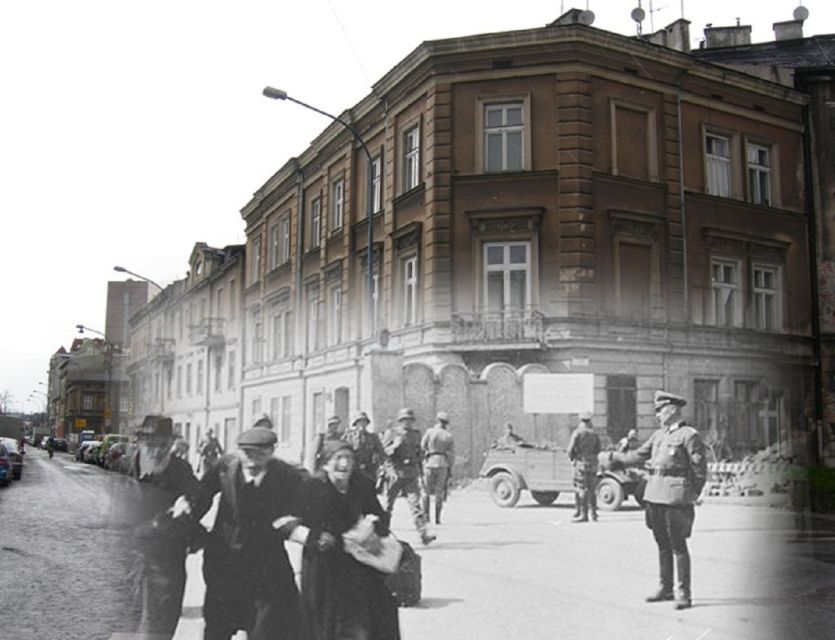
Kraków’s former Jewish ghetto still has much of its wartime street plan and many original buildings. This two-hour walk explains how the Nazi ghetto system worked, then brings that structure down to street level: walls, offices, hospitals, factories, prisons, orphanages, and homes.
I like the full-district route, which goes beyond one famous square or memorial. I also like the Spanish-speaking guide’s focus on daily life, not only dates and military events. The possible drawback is the subject itself: this is a serious, emotionally demanding walk, and two hours on foot may feel brisk if you want long pauses at every site.
In This Review
- Key points to know before booking
- Why Kraków’s former ghetto is worth seeing on foot
- Starting with the walls and the shape of confinement
- Ghetto Heroes Square and the empty chairs
- The buildings behind daily life
- Factories, labor, and the machinery of survival
- Synagogues, orphanages, and the human scale
- Ending at Pharmacy Under the Eagle
- What the $16 price really buys you
- Timing, language, and meeting details
- Who will get the most from this walk
- Should you book the Kraków Holocaust Tour?
- FAQ
- Where does the Kraków Holocaust Tour take place?
- How long does the tour last?
- What language is the tour conducted in?
- How much does the tour cost?
- What does the tour include?
- Are food and drinks included?
- Can I cancel or change my payment plans?
Key points to know before booking
- The route covers the former ghetto in its entirety, including both surviving wall fragments and the old locations of key institutions.
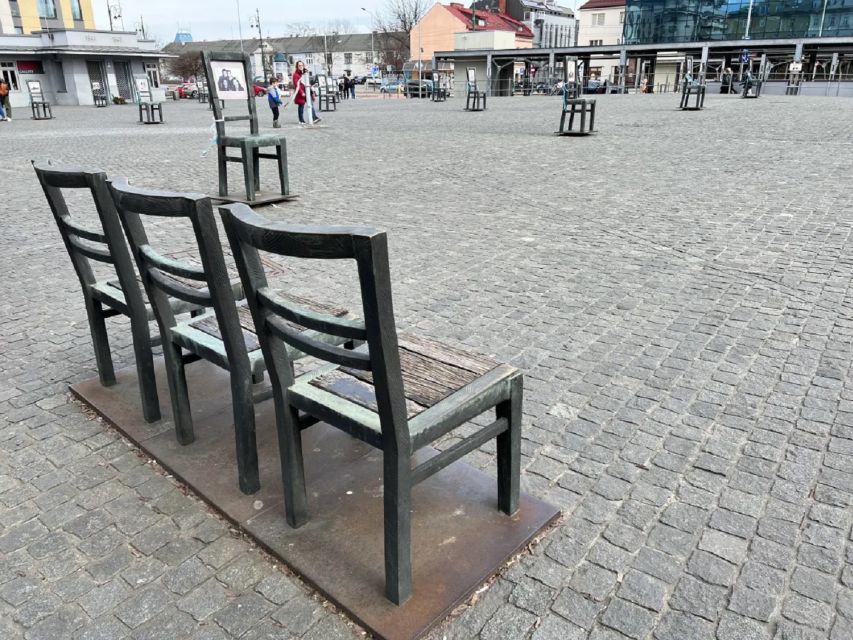
- Ghetto Heroes Square is a major stop, with its rows of empty chairs recalling the deportation of Jewish residents.
- Pharmacy Under the Eagle provides a museum visit at the end of the walk and adds an indoor historical setting.
- The guide has graduate training in Geography and History, with the tour conducted in Spanish.
- The price is $16 per person for a two-hour experience, a low-cost choice for visitors seeking context rather than a quick photo stop.
- Comfortable shoes matter, and a gray umbrella identifies the guide at the meeting point.
Why Kraków’s former ghetto is worth seeing on foot
This is not a tour built around a single monument. Its value comes from seeing how a whole neighborhood was turned into a controlled enclosure during the Nazi occupation.
The former Kraków ghetto has retained much of its wartime appearance. Old houses remain, along with many buildings that once served administrative, medical, industrial, religious, and residential purposes. That physical continuity gives the guide something important to work with. You are not only hearing about a system in the abstract. You are looking at the streets and buildings where that system operated.
I find this approach more useful than a short stop at a memorial followed by a few general facts. The walk asks practical questions: How were people confined? Who administered the area? How did work, food, medicine, policing, and housing function? What happened to children, older people, and those who could no longer work?
The subject is painful, and the district’s somber appearance can make the past feel close. You should come prepared for a quiet, serious experience rather than an ordinary city stroll.
Other Krakow trips people book alongside this one:
- From Krakow: Auschwitz-Birkenau Guided Tour & Hotel Pickup
★ 4.5 · 33,358 reviews - From Krakow: Auschwitz-Birkenau Guided Tour & Hotel Pickup
★ 4.5 · 29,340 reviews - Krakow: Auschwitz Guided Tour with Optional Hotel Pickup
★ 4.5 · 15,280 reviews
Starting with the walls and the shape of confinement
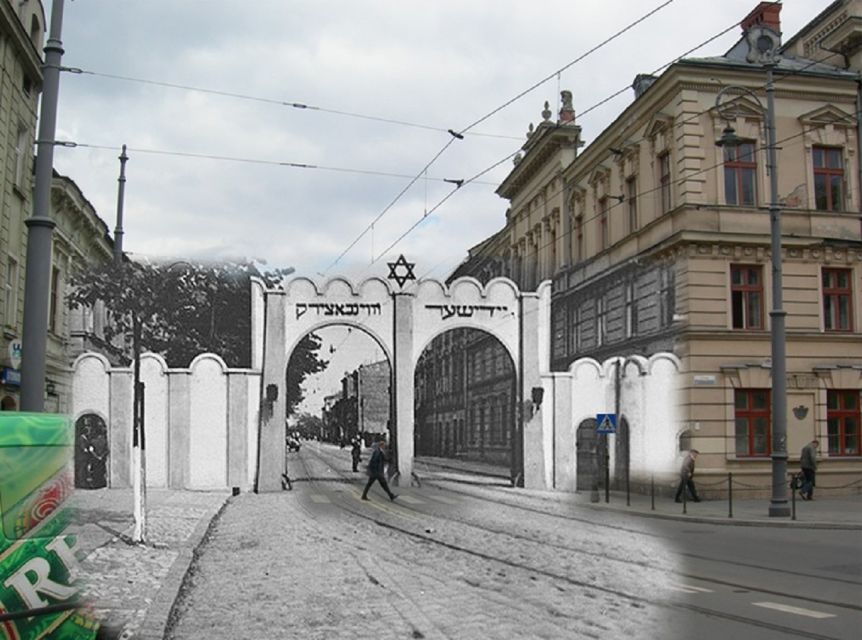
The tour includes the two surviving fragments of the ghetto wall. These are among the clearest physical reminders of how the district was separated from the rest of Kraków.
A wall can look simple at first glance. With a guide, it becomes evidence of policy. The point was not only to mark a boundary. The enclosure controlled movement, separated Jewish residents from the wider city, and helped the Nazi authorities impose surveillance and administration.
The guide explains the purpose of ghettos during the occupation and compares Kraków with other ghettos in Poland. That wider comparison matters. It helps you see which features were part of a broader Nazi system and which details were specific to Kraków.
Do not expect every section of the original wall to survive. The experience focuses on the two remaining fragments and the wider district around them. The old boundaries and building locations do much of the historical work.
Ghetto Heroes Square and the empty chairs
Ghetto Heroes Square, also known as the Square of Chairs, is likely to be the emotional center of the walk. The chairs are stark and easy to understand, but the guide gives them a human setting by explaining what happened in this part of the ghetto.
The square is tied to the removal and deportation of Jewish residents. Empty furniture suggests homes suddenly abandoned, belongings left behind, and people forced out with little control over what they could carry.
I recommend taking a moment here instead of treating the square as a quick photograph. The surrounding streets help connect the memorial to the neighborhood itself. You can better understand the scale of the disruption when you know that the ghetto was not simply a prison site. It was also a place where people were expected to live under extreme pressure before the final deportations.
The square may be familiar to visitors who have seen photographs of Kraków. The benefit of this tour is that it places the chairs within a larger route, rather than making them the whole story.
The buildings behind daily life
A major strength of this experience is the attention given to ordinary institutions. The route includes locations connected with hospitals, factories, orphanages, labor organizations, police agencies, and prisons.
These stops show why daily life in a ghetto cannot be reduced to the idea of people simply being locked behind a wall. The district had a forced internal structure. People needed medical care, work assignments, administration, schooling or child care, religious spaces, and places to meet. Nazi authorities used these needs as part of a system of control.
The guide also points out former offices connected with the Judenrat, the Jewish council forced to carry out orders under Nazi rule. This is an especially difficult subject because councils were placed in an impossible position. Understanding their role requires more care than a simple judgment about cooperation or resistance.
The tour also identifies buildings linked to intellectual meetings and resistance. Those locations help correct another common misunderstanding. Confinement did not erase community life, debate, culture, or attempts to resist. At the same time, these activities took place under constant danger and severe limits.
Because many buildings still resemble their wartime appearance, you might find yourself looking at an unremarkable facade and then realizing how much activity and suffering once surrounded it. That contrast is one of the district’s strongest teaching tools.
A different sort of day out from Krakow:
- Krakow–Zakopane: Cable Car, Chocholow Baths, Cheese & Vodka
★ 5.0 · 10,720 reviews - Krakow: Auschwitz-Birkenau Guided Tour with Pickup & Lunch
★ 4.5 · 9,800 reviews - From Krakow: Wieliczka Salt Mine Tour
★ 4.6 · 9,393 reviews - Krakow: Auschwitz-Birkenau Guided Tour Pickup/Lunch Options
★ 4.5 · 9,057 reviews
Factories, labor, and the machinery of survival
Work is an important part of the tour’s explanation of how ghettos operated. Factories and labor organizations were not just economic sites. Employment could affect access to food, movement, protection, and the chance of avoiding immediate deportation.
The guide connects forced labor with the daily struggle to survive. This is useful context because photographs of ghettos often show crowded streets or poor housing but do not explain the systems behind them. A factory location can reveal how labor was organized and exploited, while a former administrative office can show how orders reached the population.
You should listen for the difference between survival activity and genuine freedom. A person may have had a job, but that did not mean normal working life. A hospital may have existed, but that did not mean adequate medical care. A council may have administered local matters, but it did not hold real power.
That kind of distinction is where a trained guide adds value. The guide is a graduate in Geography and History and conducts the tour in Spanish. The experience has received a 4.9 rating from five verified bookings, with the strongest praise focused on clear information and an engaging manner. That combination is important for a subject that can become either too dry or too emotionally overwhelming.
Synagogues, orphanages, and the human scale
The route also includes the former locations of synagogues and orphanages. These stops bring attention to the community that existed before the ghetto was created.
A synagogue is not only a religious building. It points to a neighborhood with traditions, families, education, and shared identity. An orphanage points to children whose lives were already shaped by persecution, displacement, and loss.
These places can be harder to picture than a wall or a prison. That is why the wider route matters. Moving between civic, industrial, religious, and residential sites helps you understand that the ghetto affected every part of life.
The guide’s focus on daily routines should help you think about questions that visitors often miss. Where did people work? How did they reach a hospital? What happened to children? How were rules enforced? How did residents find information or maintain contact with others?
You will not get a light city-history walk here. The route is designed to make the district’s social structure understandable, and that requires attention.
Ending at Pharmacy Under the Eagle
The walk finishes at the famous Pharmacy Under the Eagle, one of Kraków’s major museums on the subject. This is a sensible ending because the pharmacy offers an indoor setting after a long period of walking through streets and exterior sites.
The pharmacy is linked with the wartime ghetto and gives the tour a more focused museum experience. After seeing the district as a whole, you can place the pharmacy within that setting instead of treating it as an isolated attraction.
The supplied details do not specify how much time you spend inside the museum or whether admission is included separately, so check the booking information before you pay. Food and drinks are not included.
The stop also gives you a chance to gather the themes of the walk: administration, forced movement, work, medical care, resistance, and the destruction of community life. If you prefer museums to outdoor walking, this final visit may be especially meaningful. If you want to spend a long time reading every display, two hours for the complete experience may feel limited.
What the $16 price really buys you
At $16 per person, this is inexpensive for a two-hour guided history walk in Kraków. The value comes from the route and the explanation, not from entertainment or a large number of included extras.
You are paying for a live Spanish-speaking guide with graduate training in Geography and History, a walk through the full former ghetto area, and a visit connected with Pharmacy Under the Eagle. Food and drinks are not part of the price.
For budget-conscious visitors, the tour makes sense if you want a framework for the district before exploring more of Kraków on your own. You can walk past the same buildings without understanding what they were used for. Here, the guide links them into one story.
The small number of published ratings means the 4.9 score should be treated as encouraging rather than final proof of quality. Still, the repeated praise for the guide’s information and ability to keep the subject accessible fits the design of the experience.
Timing, language, and meeting details
The tour lasts two hours and is offered with a live guide in Spanish. Check the available starting times when booking, since the start time is not fixed in the details provided.
The guide carries a gray umbrella. That is the practical sign to look for at the meeting point, especially on a busy Kraków street or in poor weather.
Wear comfortable shoes. This is an extensive walking route, and the subject is best absorbed when you are not distracted by sore feet. Bring only what you need for the walk, and dress for changing weather.
The activity is listed as wheelchair accessible. If you use a wheelchair, it is still sensible to confirm the exact route and access arrangements before booking, since the tour moves through an older urban district and includes multiple exterior locations.
You can cancel up to 24 hours in advance for a full refund. The reserve-now, pay-later option is useful if your Kraków plans are still shifting.
Who will get the most from this walk
I would choose this experience if you want a structured introduction to Kraków’s former Jewish ghetto and prefer Spanish. It suits visitors who want more than the best-known memorials and who appreciate a guide explaining how institutions worked.
It is also a good fit if you have already visited Kraków’s main sights and want to understand Podgórze through the period of Nazi occupation. The entire-district route gives you a broader sense of place than a single museum visit.
I would think twice if you want a relaxed outing, a short photo walk, or a tour with lots of food and neighborhood atmosphere. This is not a general Jewish quarter tour, and it is not designed to soften the subject.
Families with older children may find the route valuable, but the content is serious. Younger children may not be ready for the material. The accessible format and two-hour length help, but the emotional weight remains.
Should you book the Kraków Holocaust Tour?
Book it if you want a focused, low-cost Spanish-language history walk that connects walls, homes, workplaces, hospitals, prisons, religious sites, and memorials into one account of the ghetto.
Its best feature is the complete route. You are not left with only a famous square and a few dates. You see how confinement affected work, health, administration, religion, children, and resistance.
Skip it if you are looking for a cheerful city tour or if you want a long, unhurried museum visit. For everyone else, especially visitors interested in how Nazi ghettos functioned on a practical level, this is a worthwhile two hours. Wear good shoes, arrive ready for difficult material, and watch for the gray umbrella.
FAQ
Where does the Kraków Holocaust Tour take place?
The tour takes place in Kraków, in Lesser Poland, and covers the former Jewish ghetto in its entirety.
How long does the tour last?
The tour lasts two hours.
What language is the tour conducted in?
The live tour guide conducts the experience in Spanish.
How much does the tour cost?
The listed price is $16 per person.
What does the tour include?
It includes a live guide who is a graduate in Geography and History. The route includes the former ghetto area and a visit to Pharmacy Under the Eagle.
Are food and drinks included?
No. Food and drinks are not included.
Can I cancel or change my payment plans?
You can cancel up to 24 hours in advance for a full refund. You can also reserve your place and pay later.
Just added around Krakow
- Private Guided Tour: Oskar Schindler’s Factory★ 5.0 · 3 reviews
- E-Scooter Krakow sightseeing tour★ 5.0 · 3 reviews
- From Krakow: Zakopane and Thermal Pools Guided Trip★ 5.0 · 3 reviews
- Schindler’s Factory, Ghetto and Plaszow Camp Guided Tour★ 4.7 · 3 reviews
- Kraków: Private Hot Air Balloon Flight with Champagne★ 3.7 · 3 reviews
- Krakow: River Cruise & Guided Visit to Former Plaszow Camp★ 3.6 · 3 reviews
- From Krakow: Private Wieliczka Salt Mine Tour★ 4.0 · 3 reviews
- Krakow: Old Town short walk with St. Mary’s Basilica visit★ 5.0 · 3 reviews
Tours, compared.

Auschwitz-Birkenau Guided Tour & Hotel Pickup
Read our review →Auschwitz-Birkenau Guided Tour & Hotel Pickup
Read our review →
Auschwitz Guided Tour with Optional Hotel Pickup
Read our review →
Auschwitz-Birkenau Guided Tour with Pickup & Lunch
Read our review →

Auschwitz-Birkenau Guided Tour Pickup/Lunch Options
Read our review →
