
Reviewed · JEWISH GHETTO TOURS
Krakow: Jewish Ghetto Guided Tour
Krakow’s former Jewish Ghetto is easier to understand when you walk its streets rather than view it through a vehicle window. This compact tour connects the remaining ghetto wall with Ghetto Heroes Square and the Under the Eagle Pharmacy, using each place to explain the city’s wartime story.
I like the small maximum group of 20 and the simple route, which leaves your guide free to answer questions. I also like that the tour reaches a wall fragment many people would miss on their own. The main drawback is its brevity: one hour gives you a clear introduction, not a full study of Podgórze or Krakow under Nazi occupation.
In This Review
- Key points at a glance
- Why this short walk matters in Podgórze
- Starting at Lipowa 4
- The ghetto wall fragment: a rare physical reminder
- Ghetto Heroes Square and the chair memorial
- Under the Eagle Pharmacy: medicine and moral courage
- What you get for $15.60
- Guide quality and the pace of the walk
- Who will get the most from this experience
- What the tour does not cover
- Booking, weather, and cancellation details
- Should you book the Krakow Jewish Ghetto tour?
- FAQ
- How long does the Krakow Jewish Ghetto tour last?
- Where does the tour begin?
- Where does the tour finish?
- Is the tour offered in English?
- Is admission to Under the Eagle Pharmacy included?
- How early should I arrive?
- What happens if it rains?
- Can I cancel for a full refund?
Key points at a glance
- A surviving wall fragment: See one of the few physical remains of the Krakow Ghetto.
- Ghetto Heroes Square: Learn about deportations and the meaning of the chair memorial.
- Under the Eagle Pharmacy: Visit the site linked to pharmacist Tadeusz Pankiewicz and his staff.
- A focused one-hour walk: The route is short, direct, and easy to fit into a busy Krakow day.
- English guidance: Guides including Olga, Phil, Phillip, and Anna have led sessions with clear, thoughtful explanations.
- Low-cost historical context: At $15.60 per person, the tour offers a useful orientation before or after visiting nearby museums.
Why this short walk matters in Podgórze
The Krakow Ghetto is not preserved as a complete historic district. Modern streets, buildings, businesses, and ordinary city life occupy much of Podgórze today. That can make the area difficult to read if you explore it without context.
A guide helps you connect the few surviving places with the much larger story. You are not simply looking at an old wall or a square. You are learning how confinement worked, where people were forced to gather, and how deportations changed the lives of Krakow’s Jewish residents.
I find that especially useful for anyone who has already visited, or plans to visit, Schindler’s Factory. The tour does not replace a museum visit, but it adds the physical setting outside the museum. You get a better sense of distance, movement, and the places that shaped daily life in the ghetto.
The tone also matters. This is a difficult subject, and the best guides handle it with care rather than turning it into a quick list of grim facts. The guides praised most highly for this experience, including Olga, Phil, Phillip, and Anna, are described as calm, clear, friendly, and sensitive. Anna, in particular, is noted for explaining the material in an approachable way, while Olga brought energy and strong personal engagement to the story.
More Jewish heritage walks in Krakow:
- Krakow: Schindler’s Factory & Ghetto Guided Tour
★ 4.7 · 1,694 reviews - Krakow: Jewish Quarter and Former Ghetto Tour
★ 4.9 · 1,441 reviews - Krakow: Bike Tour of Old Town, Jewish Quarter and the Ghetto
★ 4.9 · 1,155 reviews
Starting at Lipowa 4
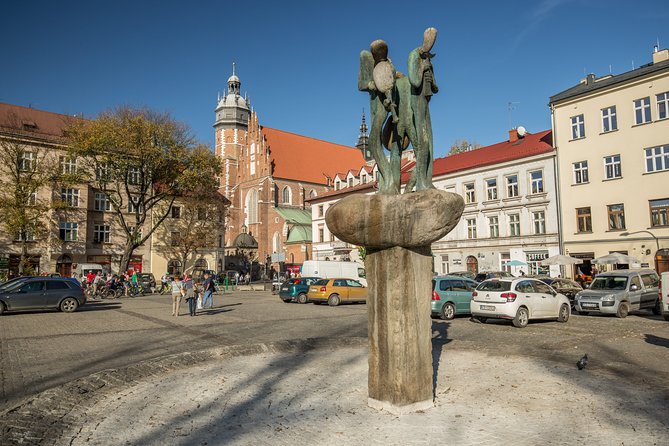
The meeting point is Lipowa 4 in Krakow, in the Podgórze area. You should arrive 10 minutes early. This is not a flexible recommendation: once the group leaves, late arrivals cannot join and the ticket is not refundable.
The start is near public transportation, but the information provided does not specify a particular tram or bus connection. Check your route before setting out, especially if you are coming from Krakow’s Old Town or another part of the city.
The walk is offered in English, and each group operates in only one language. Choose English when booking rather than assuming a multilingual group. The maximum group size is 20, though some departures may be much smaller. One family described a group of just four people, while another departure had eight. A smaller group can make it easier to ask questions and hear the guide clearly.
Wear comfortable shoes. The route is short, but you are walking and standing for about an hour. The tour runs in rain or shine, so check the forecast and bring suitable clothing. Wet weather may make the subject feel even heavier, but it will not normally stop the activity.
The ghetto wall fragment: a rare physical reminder
The first stop takes about 20 minutes and focuses on a surviving fragment of the Krakow Ghetto wall. Admission to this part of the tour is included.
This is one of the most useful stops because it gives you something physical to look at. Much of the former ghetto has changed, so the wall fragment helps make the system of confinement easier to picture. You can see the kind of barrier that separated residents from the rest of the city while your guide explains what that separation meant.
Do not expect a large, intact fortification stretching through the neighborhood. The experience is about seeing a remnant and understanding its purpose, not walking along a preserved boundary for blocks. That distinction is important. If you arrive expecting the whole district to look as it did during World War II, the modern surroundings may surprise you.
One of the strongest aspects of the stop is navigation. The fragment is not necessarily the kind of place you would locate quickly while walking between major Krakow sights. Your guide takes you directly there and supplies the missing background.
The wall also sets the tone for the rest of the hour. This is not a general sightseeing stroll through Podgórze. It is a focused visit to places connected with the ghetto, its residents, and the machinery of persecution.
Ghetto Heroes Square and the chair memorial
The second stop is Ghetto Heroes Square, about a 20-minute visit. There is no separate admission charge for the square.
This was the heart of the ghetto and a place connected with deportations to extermination camps. Your guide explains what happened here and why this open public space carries such painful meaning.
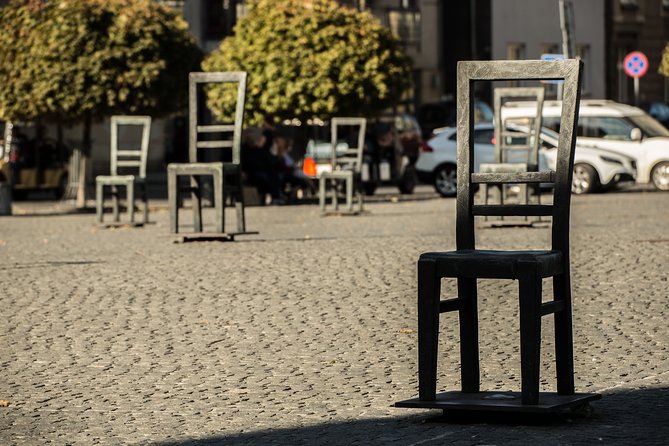
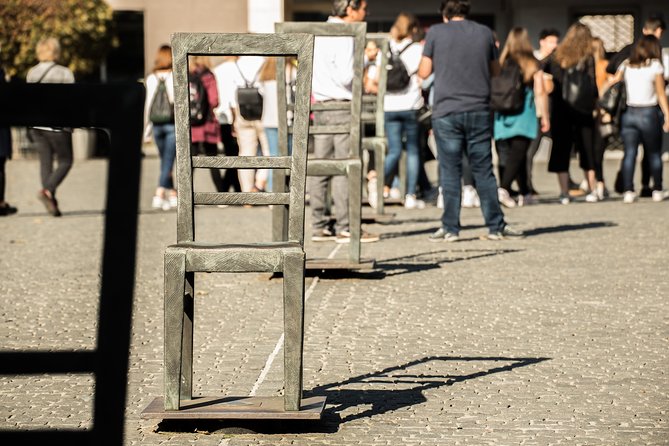
Today, the most striking feature is the Chair Memorial. The chairs are arranged across the square, and each one represents a life lost. The design is spare and easy to grasp, but it does not simplify the history. The empty chairs make the absence visible without relying on a long display of text.
I appreciate the way this stop connects a broad historical event to one specific place. It is one thing to learn about deportations in a museum gallery. It is another to stand in the square where people were gathered and forced from their homes.
The square is also a useful point for questions. If you want to understand how the ghetto functioned, ask your guide about the people who lived there, the role of the surrounding streets, or how the deportations affected Krakow. The exact amount of discussion will depend on the guide and the group, but the tour is designed to provide historical explanation rather than only a photo stop.
Keep in mind that this is an active public space. It may not feel quiet or isolated, and the modern city continues around it. That is not a flaw, but it can affect the mood and your ability to hear. Stay close enough to the guide, especially if the group is using the full 20-person capacity.
A few more Krakow trips worth comparing
- From Krakow: Auschwitz-Birkenau Guided Tour & Hotel Pickup
★ 4.5 · 33,358 reviews - From Krakow: Auschwitz-Birkenau Guided Tour & Hotel Pickup
★ 4.5 · 29,340 reviews - Krakow: Auschwitz Guided Tour with Optional Hotel Pickup
★ 4.5 · 15,280 reviews - Krakow: Auschwitz-Birkenau Guided Tour with Pickup & Lunch
★ 4.5 · 9,800 reviews
Under the Eagle Pharmacy: medicine and moral courage
The final stop is the Under the Eagle Pharmacy, located at Plac Bohaterów Getta 18. The tour ends here after roughly 20 minutes at the square.
The pharmacy is linked to Tadeusz Pankiewicz and his staff, who aided people living in the ghetto. Their work involved medicine, assistance, and preserving hope during a period when ordinary choices carried serious danger.
The pharmacy is the only stop on this route with an admission ticket not included. The tour takes you to the site, but you should expect to pay separately if you want to enter the museum. This gives you a choice: you can take the guided walk as a low-cost outdoor introduction, then decide if the interior museum fits your schedule and budget.
That flexibility helps keep the tour price low. At $15.60 per person, you are paying for the guide’s time and interpretation rather than a bundled museum admission. If you already have a full museum schedule, you can still benefit from the street-based tour. If you want more detail, the pharmacy offers a natural next step.
The ending also makes practical sense. Since the tour finishes at the pharmacy rather than returning to Lipowa 4, you can continue exploring from there. The supplied information does not promise a return transfer or a circular route, so plan your next stop from the ending point.
What you get for $15.60
The price is modest for a guided walk in a major European city, especially one that removes the need to research and navigate the area yourself. The real value is not the distance covered. It is the explanation attached to three specific places.
A self-guided walk may show you the same wall fragment, square, and pharmacy, but you could easily miss the wall or arrive without understanding what you are seeing. For $15.60, you get a fixed route, an English-speaking guide, and a clear one-hour framework.
The price does not include entry to Under the Eagle Pharmacy, so budget for that separately if you want to go inside. It also does not turn the tour into an all-day historical program. You should view it as a well-organized introduction.
I consider it good value for three types of visitors:
- You have limited time in Krakow and want the main Podgórze sites explained.
- You are visiting Schindler’s Factory and want more context outside the museum.
- You prefer a guide to lead you through a serious subject rather than relying on a phone and scattered notes.
It may be less useful if you have already spent several hours studying the ghetto in depth or want a longer tour with many additional sites. The one-hour format is its strength and its limit.
Guide quality and the pace of the walk
The strongest part of this experience is the guiding. Across the supplied feedback, the repeated praise focuses on clear explanations, strong subject knowledge, friendliness, patience, and a suitable pace. That consistency matters more here than flashy presentation.
A guide called Phil was praised for pacing the walk and explaining the connection between the ghetto and its wider history. Phillip was described as polite and well-informed. Anna was noted for her calm manner and detailed explanations. Olga was praised for her enthusiasm and passion. These names do not guarantee who will lead your departure, but they show the level of personal guidance the operator has provided on different occasions.
The pace seems suited to the subject. You are not rushed from one point to another, yet the tour remains short enough for most schedules. A group also described a late start while waiting for others who had visited Schindler’s Factory. That suggests you should not assume the walk will begin the instant you arrive, although the firm late-arrival rule means you still need to be early.
A few guides have used printed images to help explain how the area once looked. This can be especially helpful because the modern neighborhood does not fully reveal its wartime past. Still, the use of images may depend on the individual guide and should not be treated as guaranteed.
Who will get the most from this experience
This tour suits adults and older children who can engage with a serious account of World War II and the Holocaust. The information provided says most people can participate, and there is no stated special physical requirement. You should still be comfortable walking and standing outdoors for about an hour.
It is a strong choice for first-time visitors to Krakow who want a focused introduction rather than a long academic lecture. It also works well for people who prefer historical places over general city sightseeing.
Couples, families, and small groups can all use it as a starting point for a day in Podgórze. The small-group possibility is useful if you want to ask questions, though the group can reach 20 people.
I would be cautious about booking it for very young children unless you already know they can handle the subject. The material concerns confinement, deportations, extermination camps, and loss. The guide’s calm presentation helps, but the history itself remains difficult.
What the tour does not cover
A good decision depends on knowing what is missing. This is not a full tour of Jewish Krakow, nor is it a complete tour of every World War II site in the city.
The route covers three main locations: the wall fragment, Ghetto Heroes Square, and Under the Eagle Pharmacy. The information provided does not include a synagogue visit, a broad tour of Kazimierz, transportation to Auschwitz, or entry to Schindler’s Factory.
The walk also does not promise extensive interior time at the pharmacy. Since admission there is separate, you should treat the guided portion as an outdoor route ending at the museum entrance or site.
That narrow focus is not a weakness if you want Podgórze explained clearly. It is a limitation if you are hoping to cover all of Krakow’s Jewish heritage in one booking.
Booking, weather, and cancellation details
The tour is offered with a mobile ticket and confirmation is provided at booking. It is available in English, and you need to select the language when making your reservation.
The activity runs in all weather. Bring appropriate shoes and clothing, since rain can make the walk less comfortable and the route includes outdoor standing time. Arrive 10 minutes before departure, because late arrivals cannot join after the group leaves.
You can cancel for a full refund up to 24 hours before the start time. Cancellations or changes made less than 24 hours before the start are not accepted for a refund. The cut-off follows local Krakow time.
Should you book the Krakow Jewish Ghetto tour?
Book it if you want a short, affordable, carefully guided introduction to Podgórze’s wartime history. The surviving wall fragment, the chair memorial in Ghetto Heroes Square, and the Under the Eagle Pharmacy create a logical route, and the guide adds the context you are unlikely to get from a quick independent walk.
I especially recommend it before or after Schindler’s Factory. The museum and the streets serve different purposes, and together they give you a fuller sense of the area.
Skip it if you need a long tour, a broad survey of Jewish Krakow, or a package with museum admission included. For everyone else, $15.60 buys a useful hour, a clear route, and thoughtful explanations of places that can be easy to overlook.
FAQ
How long does the Krakow Jewish Ghetto tour last?
The tour lasts approximately one hour. The three listed stops are planned for about 20 minutes each.
Where does the tour begin?
The meeting point is Lipowa 4, 32-051 Kraków, Poland.
Where does the tour finish?
The tour ends at Under the Eagle Pharmacy, Apteka pod Orłem, Plac Bohaterów Getta 18, 33-332 Kraków, Poland.
Is the tour offered in English?
Yes. English is one of the offered languages, and this booking is for an English-speaking group. Group tours operate in only one language, so select your preferred language when booking.
Is admission to Under the Eagle Pharmacy included?
No. Admission to the Under the Eagle Pharmacy Museum is not included in the tour price.
How early should I arrive?
You should arrive 10 minutes before the scheduled start. Latecomers cannot join after the group has departed, and their tickets cannot be refunded.
What happens if it rains?
The tour operates in all weather, rain or shine. Check the forecast and bring suitable clothing and footwear.
Can I cancel for a full refund?
Yes. You can cancel up to 24 hours before the experience starts for a full refund. Cancellations or changes made less than 24 hours before the start are not accepted for a refund.
Just added around Krakow
- Private Guided Tour: Oskar Schindler’s Factory★ 5.0 · 3 reviews
- E-Scooter Krakow sightseeing tour★ 5.0 · 3 reviews
- From Krakow: Zakopane and Thermal Pools Guided Trip★ 5.0 · 3 reviews
- Schindler’s Factory, Ghetto and Plaszow Camp Guided Tour★ 4.7 · 3 reviews
- Kraków: Private Hot Air Balloon Flight with Champagne★ 3.7 · 3 reviews
- Krakow: River Cruise & Guided Visit to Former Plaszow Camp★ 3.6 · 3 reviews
- From Krakow: Private Wieliczka Salt Mine Tour★ 4.0 · 3 reviews
- Krakow: Old Town short walk with St. Mary’s Basilica visit★ 5.0 · 3 reviews
Jewish Ghetto Tours, compared.

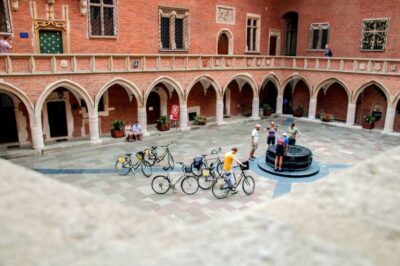
Bike Tour of Old Town, Jewish Quarter and the Ghetto
Read our review →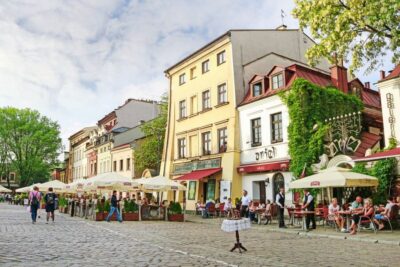
Kazimierz, Schindler’s Factory & Ghetto Guided Tour
Read our review →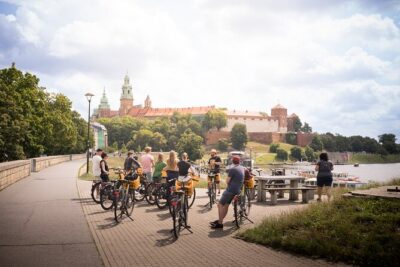
Full Bike Tour – the Old Town, Jewish Qtr & the Ghetto NEW BIKES
Read our review →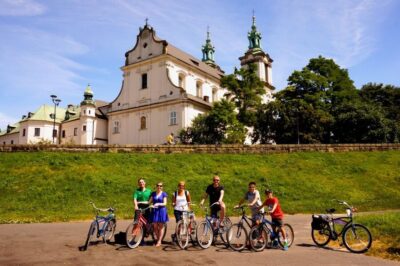
Bike Tour of the Old Town, Kazimierz, and the Ghetto
Read our review →
Jewish Quarter and Ghetto Electric Golf Cart Tour
Read our review →Browse the lists this tour appears in