
Reviewed · JEWISH GHETTO TOURS
Krakow: Plaszow Concentration Camp Guided Walking Tour
Plaszow is not a preserved camp with rows of buildings and displays. It is a quiet, open site where much has vanished, and that absence is part of what makes the visit so difficult. From Krakow’s Ghetto Heroes Square, your guide helps you connect the square’s wartime role with the forced-labor and concentration camp that followed.
I like the walk’s clear connection to Krakow’s Jewish ghetto, and I like the way guides use old photographs to show what the missing camp once looked like. Guides including Bartholomew, Barbara, and Phil have been praised for explaining the story carefully and answering questions. The main drawback is that Plaszow requires imagination: you will see memorials, earthworks, cemetery traces, and a few surviving structures rather than a fully preserved camp.
In This Review
- Key points to know before you book
- Why Plaszow feels different from other memorial sites
- Starting at Ghetto Heroes Square and Apteka pod Orłem
- Getting from the square to Plaszow
- What happened at Plaszow
- Reading the surviving features of the camp
- Oskar Schindler’s connection to Plaszow
- The guide makes the difference
- Price, group size, and what you receive
- Who should choose this walking tour
- Should you book the Plaszow tour?
- FAQ
- Where does the Plaszow tour begin?
- Where does the tour end?
- How long does the tour last?
- What language is the tour offered in?
- How much does the tour cost?
- How large can the group be?
- How physically demanding is the walk?
- Can I cancel for a refund?
Key points to know before you book
- The tour links two places: You begin at Ghetto Heroes Square, the former Plac Zgody, then continue to Plaszow.
- The site is largely open and exposed: Expect walking on uneven ground and bring comfortable shoes.
- Old photographs fill the gaps: Your guide uses images to explain buildings and camp areas that no longer survive.
- Schindler’s story is part of the visit: You learn how Oskar Schindler’s factory and work permits helped save more than 1,000 Jewish prisoners.
- The tour lasts about two hours: The group can include up to 25 people and is conducted in one selected language.
- The walk is emotionally serious: It suits you best if you want context, remembrance, and careful explanation rather than a light sightseeing outing.
Why Plaszow feels different from other memorial sites
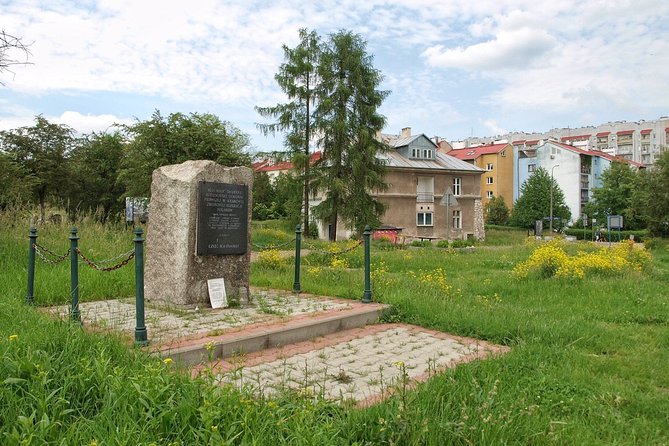
Plaszow does not offer the immediate visual clarity of a preserved camp. There are no long rows of barracks to walk through, and much of the former camp has disappeared. Instead, your guide reconstructs the place from what remains: the Grey House, ruins of the pre-burial hall, traces of the old Jewish cemeteries, the roll-call square, memorials, and fragments of gravestones once used in road paving.
That makes this a guide-dependent experience. On your own, you could walk through the area and understand very little. With a good explanation and historic photographs, the open ground becomes easier to read. You begin to see where people were held, where camp work took place, and how the site was divided.
I think that is the strongest reason to choose a guided walk here. The camp’s destruction did not erase its story, but it did make the story harder to see. A guide gives the remaining markers meaning without pretending that the site is intact.
The mood is quiet and reflective. This is not a place for casual sightseeing or a quick photo stop. You will hear about imprisonment, forced labor, executions, mass graves, and transports. Set aside time afterward if you need a slower change of pace.
More Jewish heritage walks in Krakow:
- Krakow: Schindler’s Factory & Ghetto Guided Tour
★ 4.7 · 1,694 reviews - Krakow: Jewish Quarter and Former Ghetto Tour
★ 4.9 · 1,441 reviews - Krakow: Bike Tour of Old Town, Jewish Quarter and the Ghetto
★ 4.9 · 1,155 reviews
Starting at Ghetto Heroes Square and Apteka pod Orłem
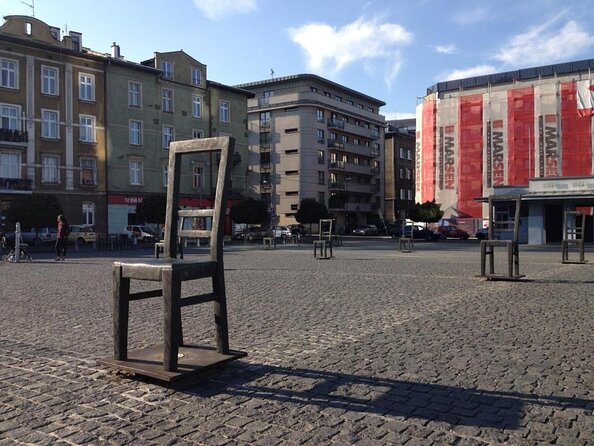
The meeting point is Apteka pod Orłem at Plac Bohaterów Getta 18. This places you at Ghetto Heroes Square, the former Plac Zgody, which served as the logistical center of the Krakow ghetto during the German occupation.
The square was used for control, registration, and the departure of transports. That detail gives the opening part of the tour a clear purpose. You are not simply meeting in a convenient city square. You are beginning at a site connected to the removal of people from the ghetto and the wider system of persecution.
The square was renamed after the war to honor the ghetto’s victims. Your guide uses the setting to establish the sequence of events before the walk turns toward Plaszow. This helps you understand that Plaszow was not an isolated camp. It was tied directly to the liquidation of the Krakow ghetto and the movement of Jewish prisoners into forced labor.
The first stop is listed as about 15 minutes. That is short, but useful. It gives you the basic setting before the main portion of the tour. The nearby pharmacy is also a meaningful meeting point because it anchors the experience in the former ghetto rather than beginning at the camp alone.
Arrive at least 10 minutes early. The group leaves on time, and latecomers cannot join after departure or receive a refund. That rule matters here because the tour moves between sites rather than waiting at a single attraction entrance.
Getting from the square to Plaszow
The connection between the two places is part of the story. One account of the walk describes taking a tram from Heroes Square to Plaszow, while the tour information presents the experience as a guided walking tour. The practical point is that you should expect movement between the city square and the camp area, not two unrelated stops.
Your guide leads the transition and continues explaining what happened to people from the Krakow ghetto. Barbara, Bartholomew, and Phil are named guides associated with particularly strong experiences, though you cannot assume which guide you will receive on your date.
The tour is offered in English, with each group using only one language. Select English when booking. The group size can reach 25 people, large enough to provide a shared experience but small enough for a guide to point out features along the route.
This is not a museum visit with a controlled indoor path. You need a moderate level of fitness and comfortable shoes. The walk includes time outdoors, and the ground around Plaszow may require more care than a normal city pavement. The practical advice is simple: wear shoes you can walk in for two hours, and avoid treating this as a stop you can squeeze between tightly timed plans.
What happened at Plaszow
Plaszow was created in October 1942 on the grounds of two Jewish cemeteries. It began as a forced-labor camp for Jewish people from the liquidated Krakow ghetto. In July 1943, a penal-labor section for Polish prisoners was added.
In January 1944, the site was redesignated as a concentration camp. Later that year, it also served as a transit camp for Hungarian Jews being sent onward to Auschwitz. More than 35,000 people were imprisoned at Plaszow during its existence, and around 6,000 were murdered.
Those figures are important, but the walk gives them a physical setting. You hear about the camp’s living areas, hospital, administrative section, and industrial areas while standing among the traces of the place itself. The guide’s job is to explain how these parts related to one another and what happened in each.
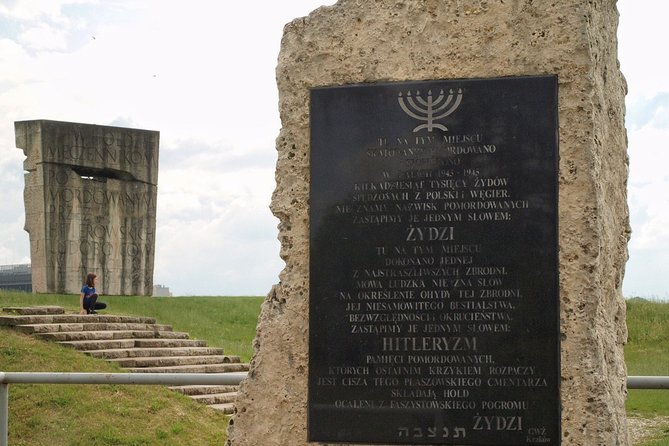
Executions took place at several points within the camp. Mass graves and memorials now mark parts of the area. The combination of a large number of victims and limited surviving structures can feel unsettling. You are asked to hold the scale of the crime in your mind while looking at a place that may appear quiet and ordinary.
That contrast is one of the visit’s hardest features. If you need a fully preserved site to understand the layout, Plaszow may feel frustrating. If you are willing to listen, look closely, and use photographs as a guide, the visit can be far more revealing than a simple walk through an empty field.
More walking tours in Krakow:
- Old Town Krakow & Wawel Castle Walking Tour
★ 5.0 · 1,508 reviews - Creepy Krakow: 2-Hour City Walking Tour
★ 4.7 · 1,131 reviews - Krakow: The Old Town Walking Tour
★ 4.8 · 794 reviews - Krakow: Kazimierz Jewish Quarter Walking Tour
★ 4.8 · 571 reviews
Reading the surviving features of the camp
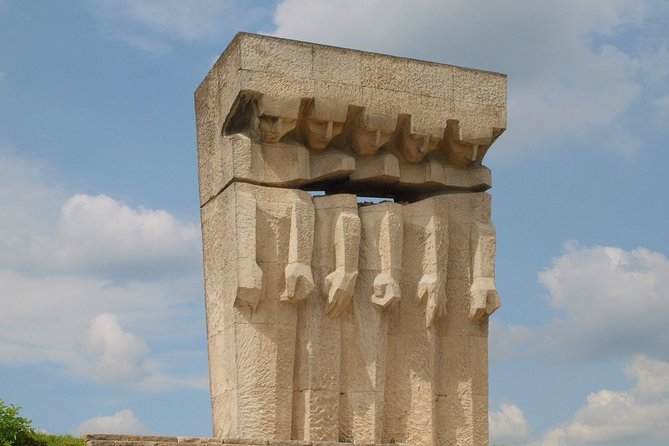
The Grey House is one of the main surviving features discussed during the walk. Your guide also points out the ruins of the pre-burial hall and traces of the Jewish cemeteries on which the camp was built.
You learn that fragments of gravestones were used to pave roads within the camp. This is a particularly stark detail because it shows how the site’s earlier Jewish identity was physically damaged and then used by the camp system. It also gives you something concrete to look for as the guide explains the ground beneath your feet.
The roll-call square helps you understand the camp’s daily control. Roll calls were part of the discipline and administration of camp life, and the area gives the guide a place to explain how prisoners were organized and monitored.
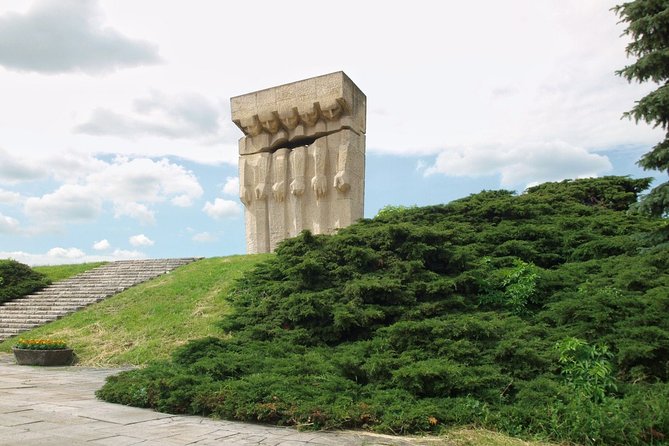
Memorials mark important points, including the Monument of Torn-Out Hearts. These are not simply monuments to photograph. They provide moments to stop and consider the people who were imprisoned and killed here. The guide’s commentary helps connect the symbolism of the memorials with the events that occurred around them.
The camp was divided into living, hospital, administrative, and industrial sections. You may not see every original boundary clearly, but the explanation gives structure to the site. This is where the tour’s use of historic images becomes especially helpful. You can compare the photograph with the present-day view and understand what has been lost.
Oskar Schindler’s connection to Plaszow
Schindler’s story is a major reason many people add Plaszow to a Krakow visit, especially after watching Schindler’s List. The film connection can help you recognize names and events, but the tour puts the story back into its real setting.
Oskar Schindler operated an enamelware enterprise and sought work permits for Jewish prisoners registered through Plaszow. Those permits could shield people from further transports. Later, he arranged for the workers to be transferred to his wartime plant in Brunnlitz.
More than 1,000 lives were saved through these efforts. The tour explains Schindler’s role as part of the camp’s wider system rather than presenting him as the whole story. That balance matters. Plaszow was a place of forced labor, imprisonment, murder, and transport, and Schindler’s actions form one thread within that larger account.
If you have watched the film, you may recognize parts of the story and see where the movie followed real events. The walk also helps correct a common misunderstanding: Plaszow was not simply a film location. It was a functioning camp with many sections, a large prisoner population, and a history that reaches far beyond the scenes most people remember from the screen.
The film connection makes this tour accessible, but you do not need to have seen the movie. The guide’s explanations of the camp, the ghetto, the cemeteries, and the memorials provide the necessary setting.
The guide makes the difference
The strongest part of this experience is the guide’s ability to turn scattered remains into a readable account. Bartholomew is praised for being informative and clear. Barbara is described as friendly, well prepared, and willing to answer questions throughout the walk. Phil is noted for taking time at the main sites and explaining what happened in detail.
Those names do not guarantee who will lead your tour, but they show the level of guide experience associated with the walk. You should expect spoken explanation, historic photographs, and time for questions rather than a simple route from one marker to another.
That format suits Plaszow. The site cannot explain itself through preserved rooms and large displays. The guide must provide the chronology, identify the surviving features, and show how the camp was arranged.
I also like that the walk gives you time to look. A rushed tour would reduce Plaszow to a list of dates and names. The accounts connected with this experience describe guides who stop at the main points and explain them in detail. That is valuable here, where the meaning of a small ruin or ground trace is easy to miss.
Price, group size, and what you receive
At $30.04 per person, this is not an expensive Krakow activity, but its value depends on what you want from the site. Admission to the square and camp is free, so you are paying mainly for the guide, the organization, the route between locations, and the interpretation of a difficult place.
I consider that a fair exchange at Plaszow. The camp’s remains are not always self-explanatory, and a two-hour explanation can save you from seeing only an empty area with memorials. You also receive the useful link between Ghetto Heroes Square and Plaszow, which would be harder to build together without a guide.
The group may include up to 25 people. That is not a private tour, and you should not expect every question to receive a long individual discussion. Still, it is a manageable maximum for an outdoor walk, especially if the guide speaks clearly and the group stays together.
The tour is booked well ahead on average, around 39 days in advance. That does not mean every date sells out, but it is a good reason to reserve early if the experience is important to your Krakow plans.
Free cancellation is available up to 24 hours before the start time. Cancellations or changes made less than 24 hours ahead are not refunded or accepted. Keep the strict departure rule in mind too, since arriving late means missing the tour without a refund.
Who should choose this walking tour
I would choose this tour if you want to understand Krakow’s wartime history through actual places rather than only through a museum display. It is also a good fit if Schindler’s List sparked your interest and you want to see the real sites connected with the story.
The walk suits adults and older children who can handle serious subject matter and about two hours of walking. You need moderate physical fitness, comfortable footwear, and a willingness to spend time outdoors.
It is less suitable if you want a polished attraction with intact buildings, many indoor exhibits, or a light afternoon activity. Plaszow can be emotionally demanding, and the missing structures mean you must listen closely and use your imagination.
I would also avoid scheduling it immediately before something that requires a cheerful mood. The tour is educational and carefully presented, but the subjects include murder, forced labor, mass graves, and deportation.
Should you book the Plaszow tour?
Book it if you want a thoughtful, guide-led introduction to Plaszow and the Krakow ghetto, especially if you value clear explanations and historic photographs. The most useful features are the route from Ghetto Heroes Square, the surviving camp traces, the memorials, and the careful treatment of Schindler’s connection.
Skip it if you prefer a fully preserved camp or a self-guided visit with lots of signs. Plaszow requires patience, attention, and comfortable shoes. For about $30, the guide adds the context that the open site cannot provide on its own, making this a worthwhile choice for a serious Krakow history visit.
FAQ
Where does the Plaszow tour begin?
The tour begins at Apteka pod Orłem, Plac Bohaterów Getta 18, 33-332 Krakow, Poland, at Ghetto Heroes Square.
Where does the tour end?
The tour ends near the bus stop at 57 Kamieńskiego Street, Krakow.
How long does the tour last?
The experience lasts approximately two hours.
What language is the tour offered in?
The tour is offered in English. Group tours operate in one language, so you should select your preferred language when booking.
How much does the tour cost?
The listed price is $30.04 per person.
How large can the group be?
The group can include a maximum of 25 people.
How physically demanding is the walk?
You should have a moderate level of physical fitness and wear comfortable shoes because the experience involves walking around Plaszow.
Can I cancel for a refund?
Yes. You can cancel at least 24 hours before the start time for a full refund. Cancellations or changes made less than 24 hours before the start time are not refunded or accepted.
Just added around Krakow
- Private Guided Tour: Oskar Schindler’s Factory★ 5.0 · 3 reviews
- E-Scooter Krakow sightseeing tour★ 5.0 · 3 reviews
- From Krakow: Zakopane and Thermal Pools Guided Trip★ 5.0 · 3 reviews
- Schindler’s Factory, Ghetto and Plaszow Camp Guided Tour★ 4.7 · 3 reviews
- Kraków: Private Hot Air Balloon Flight with Champagne★ 3.7 · 3 reviews
- Krakow: River Cruise & Guided Visit to Former Plaszow Camp★ 3.6 · 3 reviews
- From Krakow: Private Wieliczka Salt Mine Tour★ 4.0 · 3 reviews
- Krakow: Old Town short walk with St. Mary’s Basilica visit★ 5.0 · 3 reviews
Jewish Ghetto Tours, compared.

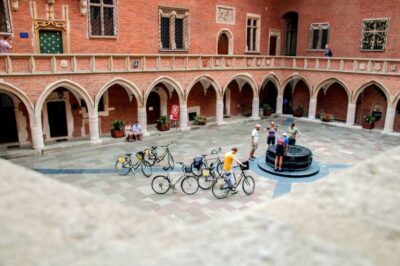
Bike Tour of Old Town, Jewish Quarter and the Ghetto
Read our review →
Kazimierz, Schindler’s Factory & Ghetto Guided Tour
Read our review →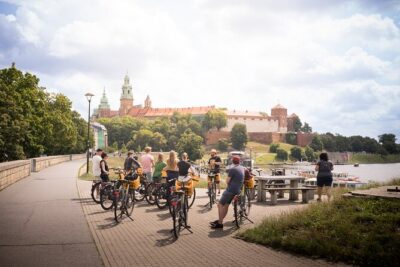
Full Bike Tour – the Old Town, Jewish Qtr & the Ghetto NEW BIKES
Read our review →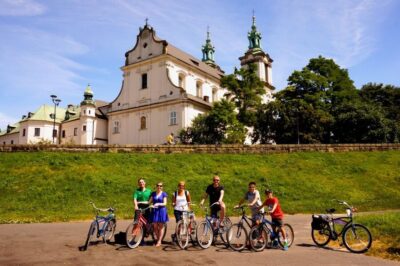
Bike Tour of the Old Town, Kazimierz, and the Ghetto
Read our review →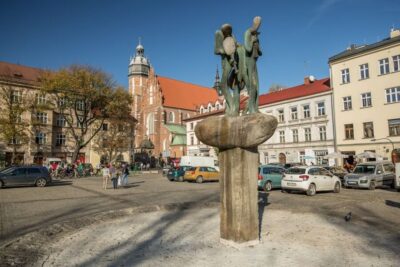
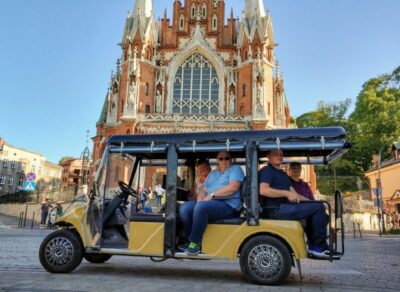
Jewish Quarter and Ghetto Electric Golf Cart Tour
Read our review →Browse the lists this tour appears in