
Reviewed · SCHINDLER'S FACTORY TOURS
Schindler’s Factory Museum
Oskar Schindler’s story is only one part of this museum. The larger subject is how Krakow changed under Nazi rule, shown through photographs, objects, posters, personal stories, and period settings inside the former enamel factory complex. The result is less a celebrity biography than a sobering account of an occupied city.
I like two things here. First, the guide gives the exhibits a human voice and places Jewish and non-Jewish life within the same wartime story. Second, the small group of up to 15 people should make it easier to hear and ask questions. The main caution is that the museum contains a great deal of written material and can become crowded, so the 90-minute guided visit may feel brisk.
In This Review
- Key points to know before you go
- Why Schindler’s Factory is about more than Schindler
- Entering the museum at Lipowa 4F
- The wartime story inside the former factory
- What the museum reveals about Krakow’s Jewish population
- Oskar Schindler’s role and the limits of the movie connection
- A 90-minute tour that may need two hours
- Is $36 a fair price?
- Who will get the most from this visit?
- Booking, language, and cancellation details
- Should you book Schindler’s Factory Museum?
- FAQ
- How long does the Schindler’s Factory Museum tour last?
- Where does the tour begin?
- How do I find the guide?
- Is the guide included in the price?
- Is transportation or hotel pickup included?
- How large is the tour group?
- What is the cancellation policy?
Key points to know before you go
- The focus is Krakow under occupation: Schindler’s role matters, but the museum also covers the invasion of Poland, Nazi control, Jewish persecution, and the city’s postwar experience.
- A Spanish-speaking local guide leads the visit: The advertised tour includes a professional guide, and guides named Lucy and Damian have been praised for adding personal stories and useful context.
- The group is limited to 15 people: That is a more manageable size than a large coach tour, especially in tight exhibition areas.
- Reserve ahead: Advance tickets help you avoid the disorder of the entrance queue, particularly later in the day and during busy periods.
- Allow extra time if possible: The booked tour lasts about 90 minutes, but the museum itself can take two hours or more if you stop to read everything.
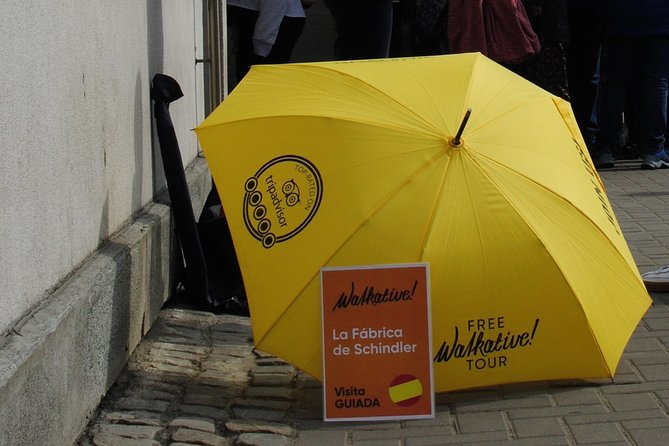
- Look for the yellow umbrella: The meeting point is at Lipowa 4F, and the guide uses a yellow umbrella to help you find the group.
Why Schindler’s Factory is about more than Schindler
The museum is built around the former enamel factory associated with Oskar Schindler, the German industrialist who saved more than 1,000 Jewish workers from deportation and death. The subject gained worldwide attention through the film Schindler’s List, much of which was filmed in and around Krakow.
But you should adjust your expectations before arriving. This is not primarily a museum about Schindler’s private life, personality, or every stage of his career. His story appears within a wider account of Krakow from the years before World War II through the Nazi occupation.
That wider focus is one of the tour’s strengths. You see how an entire city was pulled apart by invasion, racial laws, forced labor, deportation, and fear. Jewish residents faced persecution and murder, while non-Jewish Polish residents lived under military control, censorship, arrests, shortages, and the threat of punishment.
I find that context important because Schindler’s actions make more sense when you understand the system around him. The museum does not present his rescue work as a simple heroic tale. It shows a morally confused period in which survival often depended on connections, money, official documents, luck, and the willingness of individuals to take risks.
If you arrive expecting a film-themed attraction, you may find the emphasis surprising. If you want to understand the city’s wartime experience, the broader approach gives you much more to think about.
More Schindler's Factory visits:
- Krakow: Oskar Schindler’s Factory Entry Ticket & Guided Tour
★ 4.2 · 3,793 reviews - Krakow: Schindler’s Factory Tour with Entrance Ticket
★ 4.5 · 3,182 reviews - Krakow: Schindler’s Factory Skip-the-Line Ticket
★ 4.4 · 3,105 reviews
Entering the museum at Lipowa 4F
The tour begins at Lipowa 4F, 30-702 Krakow, where you meet the guide before entering. Hotel pickup is not included, and neither is transportation, so you make your own way to the factory.
The location is near public transportation. It is also walkable from the central tourist area, though the walk can take roughly 30 minutes from just outside Krakow’s Old Town. That makes the visit easy to combine with other sights in Podgórze, but you should leave enough time to arrive without rushing.
The meeting instruction is simple: look for the guide with the yellow umbrella. That detail matters at a busy museum entrance, where different queues and tour groups can make the arrival area confusing.
Advance booking is especially useful here. A person arriving without a ticket may face a wait of about 45 minutes, and ticket availability can become limited later in the day. The museum has been criticized for unclear lines between ticket holders, group tours, and people hoping to buy tickets on arrival.
With a prepaid entry and a clearly marked guide, you avoid much of that uncertainty. You still need to arrive at the correct meeting point on time, since the tour begins there and finishes back at the same place.
The wartime story inside the former factory
Once inside, the visit follows a timeline through Krakow’s experience before, during, and after the war. You encounter photographs, posters, objects, documents, and personal belongings connected with life under Nazi occupation.
The museum uses rooms and displays to show how political events affected ordinary people. The approach is not limited to military battles or famous leaders. Instead, it points you toward daily changes: who could work, travel, study, worship, or remain safely at home.
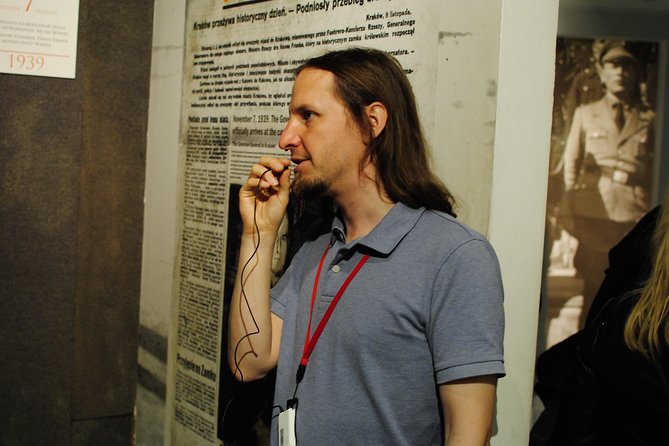
That is where a guide adds real value. A well-prepared explanation can connect a photograph or official notice with the human consequences behind it. Guides such as Lucy and Damian have been praised for explaining Polish history clearly and for adding family memories and personal anecdotes connected with the period.
The advertised language is Spanish, so confirm that this is the right option for you when booking. The tour is designed for a local, professional guide rather than a recorded audio route. That gives you the chance to ask for clarification, though the amount of discussion depends on the group and the pace of the visit.
Expect plenty to read. The museum can feel text-heavy, especially in narrow sections where people move through the displays in a set order. Red lighting in parts of the route has also been distracting for some visitors. These design choices may not work equally well for everyone, but they reinforce the uneasy mood of the exhibition.
What the museum reveals about Krakow’s Jewish population
The museum places Jewish life in Krakow within the story of the city before the occupation, then shows the increasingly brutal restrictions imposed by the Nazis. The material helps you see that persecution did not begin with mass deportation. It developed through rules, exclusion, confiscation, forced labor, segregation, and the steady destruction of normal life.
For me, this is the most important reason to visit with a guide. A display can show you a document or photograph, but a guide can explain what changed and why the change mattered. The tour also makes clear that Krakow was not a passive backdrop to the Holocaust. It was a real city whose neighborhoods, institutions, workplaces, and families were reshaped by Nazi policy.
The exhibition includes familiar Nazi symbols and wartime imagery. Some displays may be upsetting, especially for younger visitors. Admission is recommended for people aged 14 and older, which is a useful guide for families deciding if the museum is suitable.
This is not an entertainment stop. Even the parts connected with the movie lead back to real people and real suffering. Give yourself time to pause, and do not expect to move through every panel at the same speed as the group.
More museums in Krakow:
- Auschwitz-Birkenau Museum and Memorial Guided Tour from Krakow
★ 4.5 · 1,510 reviews - Krakow: Rynek Underground Museum Guided Tour
★ 4.6 · 1,122 reviews - Krakow Schindler’s Factory Museum Guided Tour in English
★ 4.5 · 650 reviews - Krakow: Auschwitz Birkenau Museum Guided Tour with Pickup
★ 3.6 · 544 reviews
Oskar Schindler’s role and the limits of the movie connection
The Schindler story is present, but it is not spread evenly through the entire museum. Some people may feel that the exhibition spends too little time on Schindler himself and focuses on him most directly near the end of the guided route.
That can disappoint anyone who booked mainly to learn more about the man portrayed in Schindler’s List. The film is a useful entry point, but the museum does not simply recreate the movie or provide a scene-by-scene explanation.
I see this as a matter of expectations rather than a flaw in the whole visit. Schindler’s rescue of more than 1,000 Jews is remarkable, but understanding the surrounding occupation gives his choices their full weight. The tour asks you to look beyond one famous German and consider the people who lived under the regime he sometimes opposed and sometimes worked within.
The museum is located in the former administrative building connected with the factory. The main factory structure still has a different use, so do not expect the entire industrial site to operate as one large museum. The displays are the main attraction, not a preserved factory floor filled with machinery.
A 90-minute tour that may need two hours
The official experience lasts approximately one hour and 30 minutes. That is a reasonable length for a guided introduction, but it may not be enough if you want to read every panel and examine every object.
Some people spend just over two hours inside and still feel they could have stayed longer. I suggest treating the 90-minute booking as the guided core of the visit, not necessarily the total time you will need at the museum.
The pace may be controlled by the guide and by the movement of other groups. In crowded periods, narrow corridors can slow everyone down. If you want a quiet, unhurried visit, arrive early in the day if your schedule allows. Early arrival may also improve your chance of obtaining a same-day ticket, though booking ahead remains the safer choice.
One practical detail: luggage storage is available at the museum. That can help if you are between hotels or carrying a larger bag, though leaving unnecessary luggage behind will make the visit easier in crowded rooms.
The ticket does not allow you to leave and return. Plan your restroom stop, food break, and transport needs before entering.
Is $36 a fair price?
At $36, this is more expensive than simply finding a museum ticket on your own, assuming a direct ticket is available. You are paying for the entrance, VAT, a local professional Spanish-speaking guide, and the convenience of avoiding the main ticket queue.
The value depends on what you want. If you read English or Polish comfortably, enjoy researching before a visit, and prefer to move at your own pace, a self-guided museum entry may suit you better. Several people find the displays clear enough to explore without a guide.
I think the guided option earns its price when you want the political and human context explained as you go. The best guides connect Krakow’s prewar life, the Nazi occupation, Jewish persecution, Schindler’s factory, and the postwar years under Soviet communism. That is a larger story than the name on the museum entrance suggests.
The group limit also matters. Fifteen people is not private touring, but it is small enough to be more personal than a large group. You may be able to hear the guide better and ask a question without stopping a crowd.
Still, $36 will not guarantee a calm visit. The museum controls its own internal crowding, and staff behavior or busy galleries are outside the tour company’s control. The guide can improve your understanding, but cannot remove every practical frustration.
Who will get the most from this visit?
I recommend this tour if you want a structured introduction to Krakow’s wartime story and prefer listening to a guide rather than reading every panel alone. It also suits people who know the film but want a wider account of Poland under occupation.
History-minded adults, older teenagers, and visitors with a serious interest in World War II will find the subject matter worthwhile. The suggested minimum age of 14 is sensible, since the material deals with persecution, death, and wartime trauma.
You may want to skip the guided option if your main goal is a detailed biography of Oskar Schindler. You may also prefer a self-guided visit if you need a slow pace, dislike crowded museum routes, or already know a great deal about Nazi-occupied Europe.
The museum can be emotionally heavy and visually intense. Give it a place in your day when you are not rushing to a cheerful dinner or another major attraction immediately afterward.
Booking, language, and cancellation details
The tour is operated by Walkative! TOUR and is offered with a local professional guide in Spanish. Confirmation is provided when you book, and the activity is suitable for most people according to the supplied tour information.
The meeting and end point are both at Lipowa 4F. There is no hotel pickup and no included transportation. Public transportation is nearby, and walking from the Old Town is possible if you allow about half an hour.
Free cancellation is available up to 24 hours before the local start time for a full refund. Cancellations or changes made within 24 hours are not accepted for a refund.
Should you book Schindler’s Factory Museum?
Book it if you want the wider story of Krakow under Nazi occupation, not just a film-related stop about Oskar Schindler. The Spanish-speaking guide, queue-free entry, and group limit make the $36 price reasonable for visitors who value explanation and structure.
Go early or reserve ahead, and allow more than 90 minutes if you want time to read. If your interest is only Schindler’s personal biography, or if you strongly prefer quiet, independent museum visits, buying a direct ticket and exploring alone may be the better choice.
FAQ
How long does the Schindler’s Factory Museum tour last?
The guided activity lasts approximately one hour and 30 minutes. You may need two hours or more if you want to read the displays in detail.
Where does the tour begin?
The meeting point is Lipowa 4F, 30-702 Kraków, Poland. The activity also ends back at this meeting point.
How do I find the guide?
Look for the guide carrying a yellow umbrella at the meeting point.
Is the guide included in the price?
Yes. The experience includes a local professional guide in Spanish, along with museum admission and VAT.
Is transportation or hotel pickup included?
No. Hotel pickup and transportation to the attraction are not included. The museum is near public transportation.
How large is the tour group?
The activity has a maximum of 15 people.
What is the cancellation policy?
You can cancel up to 24 hours before the experience start time for a full refund. Cancellations or changes made less than 24 hours before the start time are not refunded.
Just added around Krakow
- Private Guided Tour: Oskar Schindler’s Factory★ 5.0 · 3 reviews
- E-Scooter Krakow sightseeing tour★ 5.0 · 3 reviews
- From Krakow: Zakopane and Thermal Pools Guided Trip★ 5.0 · 3 reviews
- Schindler’s Factory, Ghetto and Plaszow Camp Guided Tour★ 4.7 · 3 reviews
- Krakow: River Cruise & Guided Visit to Former Plaszow Camp★ 3.6 · 3 reviews
- From Krakow: Private Wieliczka Salt Mine Tour★ 4.0 · 3 reviews
- Kraków: Private Hot Air Balloon Flight with Champagne★ 3.7 · 3 reviews
- Krakow: Old Town short walk with St. Mary’s Basilica visit★ 5.0 · 3 reviews
Schindler's Factory Tours, compared.

Oskar Schindler’s Factory Entry Ticket & Guided Tour
Read our review →
Schindler’s Factory Tour with Entrance Ticket
Read our review →
Schindler’s Factory Tour with Entrance Ticket
Read our review →
Schindler’s Factory in Krakow: Guided Tour & Skip the Line Ticket
Read our review →

Schindler’s Factory Ticket with Guided Tour Option
Read our review →
Krakow Schindler’s Factory Guided Tour with Admission Ticket
Read our review →Browse the lists this tour appears in